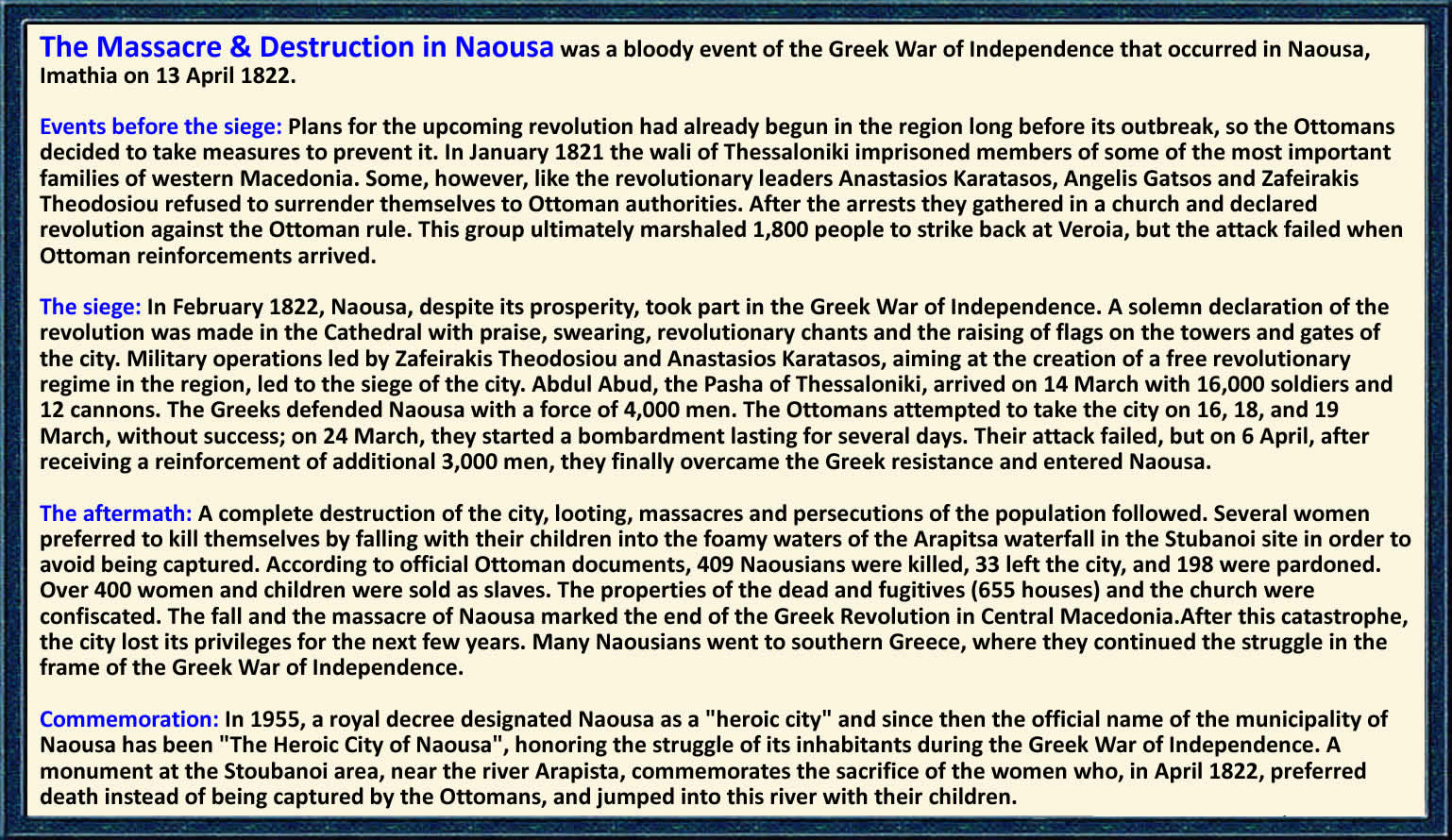
The destruction of Naousa in 1822 was one of the bloodiest episodes of the Greek War of Independence. After the Ottoman forces captured the city following fierce resistance, civilians—including women and children and members of prominent revolutionary families—were subjected to captivity, killings and severe mistreatment.
Among the stories preserved in historical accounts are those concerning the wives of leading figures of the Naousa uprising, including Zafeirakis Theodosiou and Anastasios Karatasos.
According to accounts attributed to the French traveler François Pouqueville and later Greek historical writers, women captured after the fall of Naousa were subjected to brutal punishments in Thessaloniki. Some accounts describe women being smeared with honey and exposed to insects, while others were reportedly imprisoned in sacks containing animals. These descriptions are part of a broader body of accounts concerning the treatment of Naousa's captives after the city's destruction.
The wife of Zafeirakis is traditionally identified in later accounts as having been taken to Thessaloniki after the fall of Naousa. One frequently repeated account states that she was buried or enclosed up to the neck in a wall, where she remained exposed for several days. According to that tradition, she eventually died after five days.
Another story concerns the wife of Karatasos, who is said in historical and later commemorative accounts to have suffered a particularly gruesome death after refusing to renounce her Christian faith. Sources differ in the precise details of these episodes, and some later retellings combine or modify elements of earlier narratives.
The suffering of Naousa's women was not limited to the prominent families. Contemporary and later accounts describe widespread killings, enslavement and the captivity of women and children following the city's fall. Other women chose to escape captivity by throwing themselves into the waters of the Arapitsa River. The site at Stoumpanoi is today marked by a monument commemorating the women and children who died there in April 1822.
The destruction of Naousa became one of the defining tragedies of the Greek Revolution in Macedonia. The city had risen against Ottoman rule in early 1822 under leaders including Zafeirakis, Karatasos and Angelis Gatsos. After weeks of resistance, overwhelming Ottoman forces captured Naousa, followed by widespread destruction and the killing or enslavement of large numbers of inhabitants.
The stories of the women who survived the fall only to face captivity and torture became deeply embedded in the historical memory of Naousa. Their fate, together with the mass death of civilians and the sacrifice of women at the Arapitsa River, remains an enduring part of the city's history and of the wider story of the Greek War of Independence.
DEVOUT MUSLIMS DID THIS |