 |
 |
 |
 |
 |

| Jean Garceau was the personal secretary and business manager of Clark Gable. She played a significant role in Gable's life, providing him with support and insight during his career in Hollywood. Garceau's account of Gable's life, chronicled in the book "Dear Mr. G." by Garceau, reveals Gable's personal struggles and triumphs, highlighting his sense of humor and humility.
The funeral of Carole Lombard: "This is to be a private funeral for Mrs Elizabeth Peters and her daughter Carole", he said. The services were held at the Church of the Recessional in Forest Lawn on January 22nd 1942. They were conducted by the Reverend Gordon C. Chapman of Westwood Hills Methodist Church. Only members of the immediate family and a few close friends were in attendance. The service was as Carole directed: no ritual prayers, no songs or hymns, no music other than the organ. The Reverend Chapman read from the Fourteenth Chapter of John and the Twenty-Third Psalm. A four-line poem loved by Carole and Bessie was recited, followed by a simple affirmation of faith. After the ceremony we all went back to the ranch with Clark, Howard Strickling, Eddie Mannix, Nat Wolff and his wife and a few other intimate friends spent the evening there. Harry Fleischmann planned to stay with Clark several days During the evening, I went into my office to attend to several details and Clark followed me, closing the door behind him. I still had a last note from Carole, which she'd asked me to give him if she did not arrive on schedule. I felt he should have it now. Up until this time, Clark had borne himself with fortitude and courage, had been stronger than any of us throughout the entire ordeal. When he read her note, he broke down completely. It is a dreadful thing to see and hear a strong man cry. My own heart was so full I felt it would be cruel to witness his agony. To spare him embarrassment, I turned to leave but he caught my hand and held it. All I could do was stand by his side, lending what strength and comfort I could muster until he was calm again. That night, in my office at the ranch, we said our goodbyes to Carole. After that Clark was in perfect control, his grief masked. He asked no sympathy, wanted none, was unapproachable. Howard had told me that Clark was afraid that I might not want to stay on at the ranch now that Carole was gone. Before we rejoined the others, Clark asked me if I would continue as before, in my capacity as his secretary-business-manager. There was no thought in my mind other than to remain and be of help to him if possible in the days ahead. My warm and wonderful friendship with Carole was ended. Now I was to begin a close and rewarding association with Clark, one that was to last for eighteen years. |
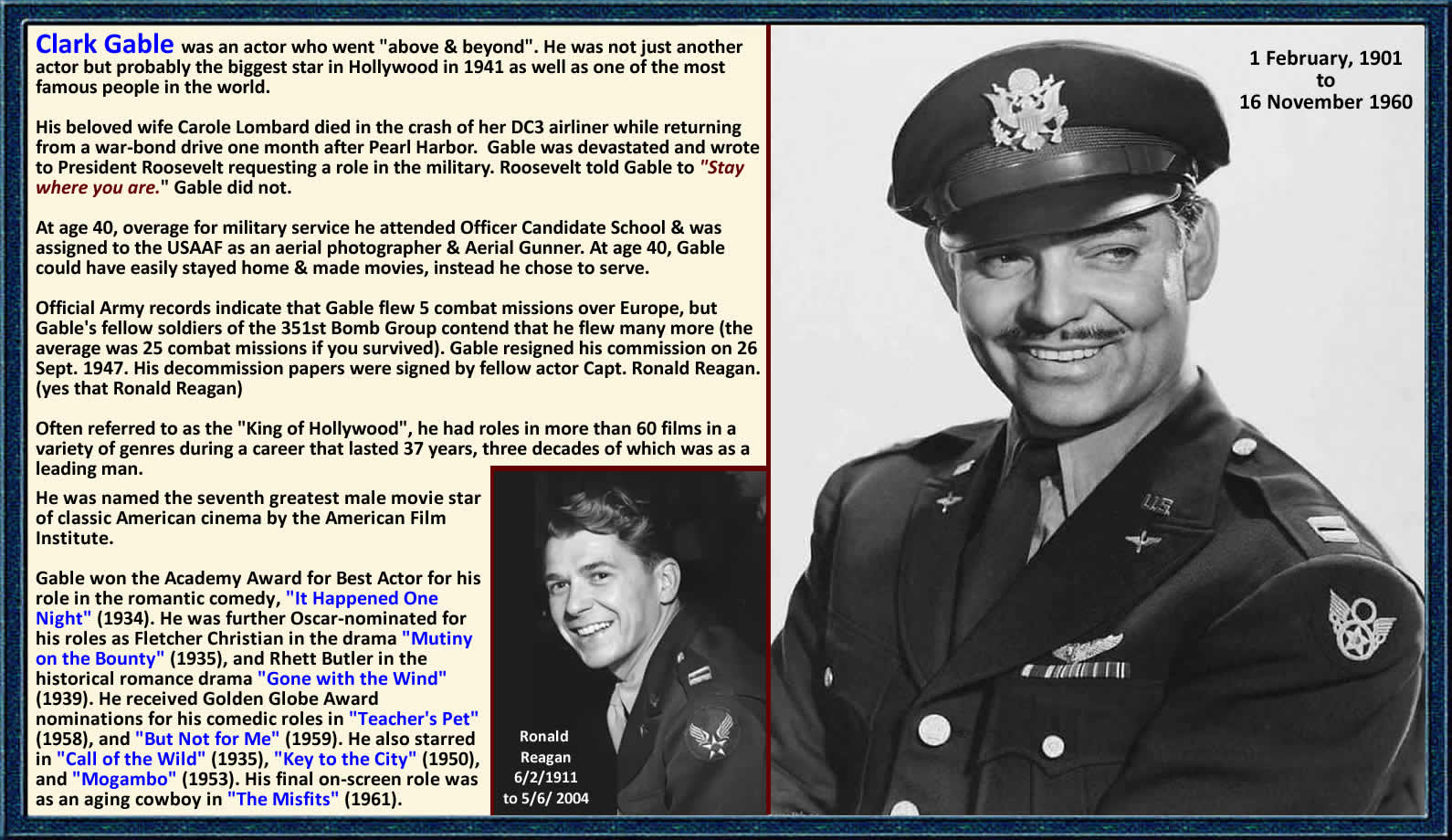
Clark Gable was a patriot, and it was ALWAYS a question of WHEN he would enlist not IF. When Carole Lombard died so suddenly and tragically while aiding the war effort, the shock catapulted Gable into the seriousness of the situation, which had seemed so far away from Hollywood and his blissful marriage. Carole and Clark had often discussed his enlisting, even though President Roosevelt, and MGM of course, were against it. When Clark had completed his obligations to MGM, and recovered enough to think straight, he knew that his next step was to enlist, simple as that, even though he would be training and later working alongside much younger men, some aged only 19 years of age. He asked for no special attention or treatment, and wanted to be sent "where the going was rough". In 1942, Gable enlisted in the U.S. Army Air Forces. He started as a private, declined special treatment, and earned his commission through Officer Candidate School. By 1943, he was a Captain stationed in England with the 8th Air Force at RAF Polebrook. |