 |
 |
|
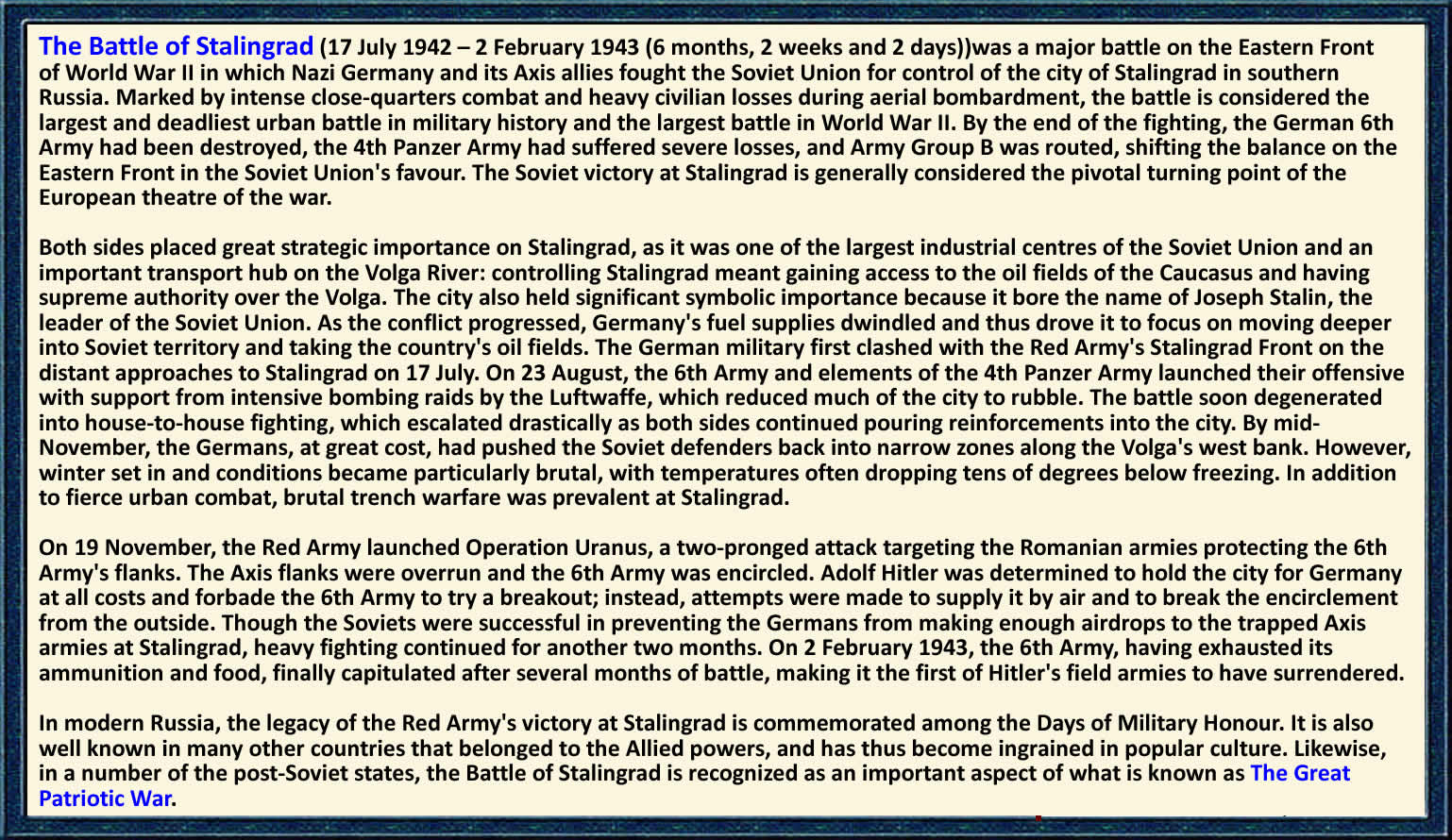
Stalingrad: the single greatest battle in history
Despite the grim reality from Berlin, Hitler still issued the final command, no retreat. That extremism transformed Stalingrad into a massive mass grave. Among the 91,000 soldiers who surrendered that day, barely more than 5,000 survived to see their homeland once again. So, what really happened within that fateful encirclement? And what crimes turned Stalingrad into the mass grave of the Third Reich? Let us decode this right now. The root of hatred, from ambition to atrocity. The seeds of the Stalingrad tragedy did not begin with the gunshots on the Vular River, but with the rise of Adolf Hitler in Berlin. As soon as he took the chancellor’s seat in 1933, Hitler began tearing up the Treaty of Versailles by secretly rebuilding the military. By 1935, the expansion was no longer a secret. Germany publicly rearmed, established the Luftvafa Air Force, and imposed mandatory conscription. To solidify his position, Hitler quickly established the Rome Berlin Axis with Mussolini and signed the anti-comm pact with Japan, creating a united front aimed directly at the Soviet Union. During the years 1938 and 1,939, Austria and Czechoslovakia were annexed one after another under the guise of living space. On the 1st of September 1939, the invasion of Poland officially opened fire, plunging the globe into the vortex of World War II. However, every victory in Europe was merely a stepping stone for the ultimate goal, Operation Barbarasa. On the 22nd of June 1941, 3 million German soldiers poured across the Soviet border, beginning a war without humanitarian rules. This was no ordinary military operation, but a war of ideological annihilation between fascism and communism, a racial purge by the self-proclaimed Arans against Slavs and Jews. Within that torrent of violence, the Sixth Army no longer maintained the role of a pure regular army. They became those who directly dipped their hands in blood. Under the command of Valter von Reichenau, this army complied with and provided logistical support for the Inats group and death squads to commit the most cruel acts in history. At the Babanya Ravine on the outskirts of Kev in just 48 hours at the end of September, 1,941 33,771 Jews were herded to the edge of the abyss, forced to strip naked and gunned down on mass with machine guns. bodies piled up in layers, including those buried alive as earth and stone collapsed into the ravine. The cruelty continued to escalate in the town of Bilatva. After assisting in the shooting of 800 adults, sixth army soldiers herded 90 children from infants to 12year-olds into an abandoned building, leaving them in hunger and fear for 2 days and nights amidst heartbreaking cries. Despite weak intervention from military chaplain, Reichonau ordered the execution of all these children to clean up the consequences. Soldiers of the Sixth Army fired directly into the heads of the innocent children, many of whom were hit four to five times before they stopped breathing entirely. The gunshots at Bilaturk not only took the lives of innocent souls, but also stripped away the path of survival for the army itself. Later on, when hatred is swn with blood and the corpses of children, Stalingrad would be the place where they had to harvest the most grim conclusion. The white hell of stalingrad, the collapse of a monument. In August 1942, the spearhead of the sixth army reached the vulgar river. Here, the pride of the German blitzkrieg tactics completely shattered before a new form of warfare, Ratten, the war of the rats. For 5 months, Stalingrad turned into a massive meat grinder where soldiers from both sides fought over every kitchen, every staircase, and every square meter of rubble. The Soviet Red Army turned every house into a fortress, forcing the German army to pay with thousands of lives for every meaningless advance. The strategic blunder of the German high command lay in underestimating the will of the opponent and the resilience of a people defending their final piece of land. On the 19th of November 1942, destiny knocked on the door. The Soviet Union launched Operation Uranus, a lightning counteroffensive, striking directly at the weak flanks of the Romanian and Hungarian forces. Within just a few days, two giant pincers closed shut, trapping nearly 300,000 German troops in a deadly encirclement known as the Stalingrad pocket. From this point, Aryan pride began to be crushed by the cruelty of nature and extreme starvation. True horror began when the Russian winter arrived. Temperatures rapidly hit the -30̊ C threshold while German soldiers were still wearing thin summer uniforms. The cold did not just freeze weapons. It froze human flesh. Thousands of soldiers suffered the rotting of toes and fingers due to frostbite induced necrosis. Aerial resupply lines were paralyzed, turning food into a distant luxury. A soldier’s daily ration was slashed to just a scrap of black bread made from flour mixed with sawdust and a bit of thin soup that was no different from plain water. To survive, those who once considered themselves superior had to skin dead horses or even scavenge scraps of food from the frozen corpses of their comrades. As vitality exhausted, disease began to sweep through. lice swarmed in the damp and low trenches carrying the pathogens of typhus and dissentry. The medical system completely collapsed. The wounded were left to die in makeshift hospitals filled with foul stenches and human remains. The horrific pressure from relentless artillery, the frigid cold and hunger pushed the psychology of this army to the brink of the abyss. Despair turned into a widespread wave of suicide. Many soldiers chose to turn their guns on their own heads or walk out of the trenches to become bait for Soviet snipers instead of enduring the prolonged torture of the White Hell. Stalingrad at this time was no longer a military objective. It had become a black hole swallowing every last hope of the Third Reich. Hitler’s gamble and the choice of Friedrich Paulus. In late January 1943, as the final gunshots of the Sixth Army gradually faded in the ruins, Adolf Hitler played a dark psychological card. On January 30, exactly on the 10th anniversary of his rise to power, Hitler signed the order promoting Friedrich Paulus to the rank of field marshal. In German military history, no Field Marshall had ever been captured alive on the battlefield. This was not an honor, but a murderous gift. By this decree, Hitler indirectly sent a cruel command. Paulus must commit suicide. Hitler wanted to use the death of Paulus to create a heroic symbol of martyrdom, covering up his own humiliating failure at Stalingrad. However, Hitler’s gamble failed miserably. Standing among the frozen corpses of tens of thousands of abandoned subordinates, Paulus refused to become a sacrificial porn for the hollow glory of the empire. On the morning of the 31st of January 1943, as the Soviet Red Army surrounded the Univag department store where the German headquarters were located, Field Marshall Polus chose to lay down his arms. In the damp, filthy, and foul smelling basement, the new Field Marshall spoke a sentence of utter contempt, aimed directly at the man sitting in the warm bunker in Berlin. I have no intention of shooting myself for this Bohemian corporal. Paulus’ act of surrender dealt a fatal blow to the self-esteem of Nazi Germany. When the news flew back to Berlin, Hitler fell into a state of extreme rage. He screamed, smashed tables and chairs, and cursed Paulus as a coward who had betrayed the Prussian spirit. Hitler could not accept that a German field marshall would choose to live in the humiliation of captivity instead of using a pistol to end his own life to become a god in Valhalla. Berlin’s anger was not only for Paulus, but also a bitter admission that the invincible war machine had officially broken, and the man who led it had chosen the path of life to testify to the insane mistakes of a dictator. Aftermath and the grim fate of the prisoners. The surrender of the Sixth Army produced a chilling statistic. 91,000 German soldiers were herded into captivity, including 24 generals. But survival at Stalingrad was merely a passport to hell on Earth. When the war ended many years later, only a meager 5,000 to 6,000 people were able to set foot back in their homeland. This horrific mortality rate of over 90% was not simply due to natural conditions, but was a combination of disease, exhaustion, and partly a silent Soviet revenge for the blood debts the German army had incurred at Babinar or Bilatva. The journey to the Gulag camps was a brutal natural purge. Tens of thousands of prisoners were shoved into cramped livestock cars without food, without water, through snowstorms to the farthest reaches of Siberia or the deserts of Usbekistan. Here they were drained of their labor in deep mines or ancient Arctic forests. Under the cold of -40̊ C, emaciated prisoners who were only skin and bones had to carry giant tree trunks or dig earth and stone with frozen bare hands. Anyone who fell from exhaustion was left to die or was buried shallowly under the snow. The most horrific obsession in the labor camps was hunger. Rations were merely bowls of thin soup mixed with tree bark and scraps of black bread as hard as stone. Extreme starvation collapsed humanity, turning soldiers who were once proud of Prussian discipline into wild beasts. In the darkness of the barracks, cannibalism appeared. A disgusting truth proving the complete collapse of civilization under the pressure of survival instinct. Typhus and dissentry swept through the rows of isolation buildings turning the prison camps into nameless mass graves. For field marshal Friedrich Paulus specifically, his fate followed a different turn. Instead of dying in the mines, Paulus became a strategic porn in the hands of Stalin. He was taken to Moscow, joined the National Committee for a Free Germany, and began a propaganda campaign calling on German soldiers to betray Hitler. In 1946, at the Nuremberg trials, Paulus appeared as a witness for the Soviet side, directly exposing the invasion plots of the Nazi war machine. This betrayal caused him to be considered a criminal in West Germany, but he was well utilized in East Germany until his death in 1957. However, the survival of Paulus cannot overshadow the truth that he abandoned his 90,000 subordinates to vanish into thin air in the dead lands of the Soviet Union. |