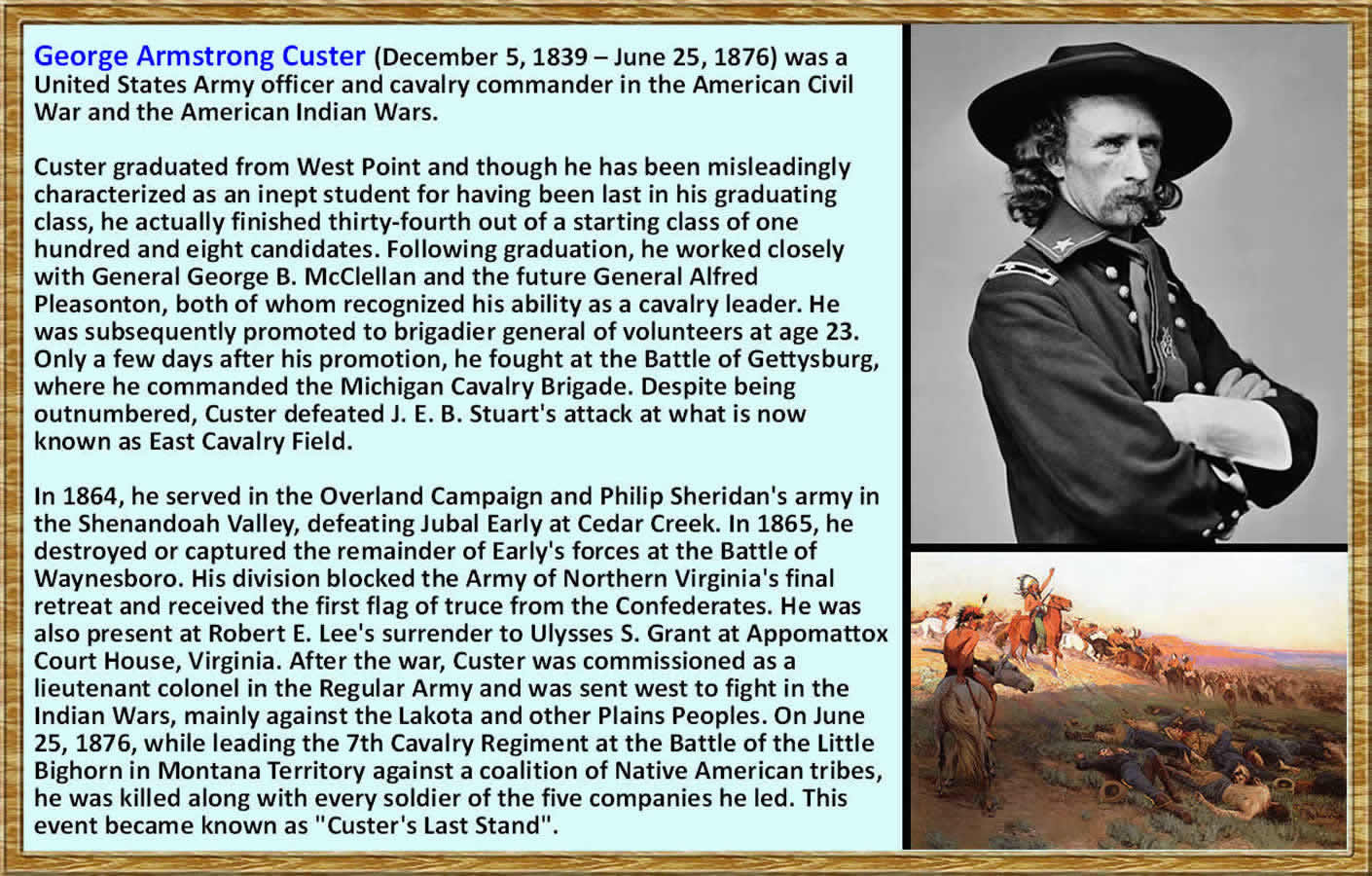
| Chief Gall's Eyewitness Account Reveals Disturbing Details of Custer's Last Stand (LINK) When Lieutenant Colonel George Custer arrived at the Little Bighorn in June of 1876, the Hunkpapa Sioux warrior known as Chief Gall had only a few hours of warning. At thirty-six years old, Gall was already a seasoned fighter whose courage and skill had earned him a place among the most respected warriors of his people. His reputation was so significant that Chief Sitting Bull had adopted him as a younger brother and counted him among his closest advisers. What Gall witnessed that day would become one of the most remarkable firsthand accounts in American military history — told from the side that history had largely ignored. On the morning of June 25th, 1876, Sioux scouts discovered ration boxes dropped by Custer's men a few miles from the village. When American soldiers spotted the scouts and drove them off, Custer realized his presence was known. Feeling he had no choice but to strike before Sitting Bull could move the village, he pressed forward with urgency. Sitting Bull summoned his leaders to council while scouts tracked the soldiers' movements. Reports soon confirmed that the American force had divided into multiple columns. Custer personally led five companies over the bluffs to strike from the north. Major Marcus Reno took three companies to attack from the south. A third column under Captain Frederick Benteen planned to cross the river far to the south and close in from the west. The intention was to surround the village completely and leave no avenue of escape. The Sioux leadership agreed their best option was to break camp and move before the soldiers could close in. But they had underestimated how quickly Reno's men would advance. Before the village could move, gunfire erupted from the south as Reno's cavalry charged through the trees toward the camp. Gall's section of the village sat directly in Reno's path. In the chaos of those opening moments, Gall rushed to find his family. What he found instead changed everything. His two wives and three children had been caught in the crossfire and were gone. "They were killed there by the pale-faced warriors," Gall later said, "and it made my heart bad." For the Sioux, this phrase described a combination of grief, despair, and deep rage. "After that," he continued, "I killed all my enemies with the hatchet." To abandon a rifle and fight with a hatchet was a warrior's declaration that vengeance mattered more than safety. Reno's men had advanced on foot and opened fire into the camp from a line formation. Gall joined the warriors pushing back against the attack. The Sioux countered with both rifle fire and mounted charges. Reno's force of roughly 150 men quickly found themselves overwhelmed as hundreds of warriors rushed to the defense, with more arriving by the minute. Among the American scouts that day was a man named Bloody Knife — half Aricara and half Hunkpapa Sioux, and a lifelong enemy of Gall. The two had grown up together before a bitter falling-out drove Bloody Knife to leave the tribe and join the Americans. When Bloody Knife was shot and killed beside Major Reno, the shaken commander ordered an immediate withdrawal. Reno's retreat back toward the river was chaotic, with Gall and his warriors pressing hard in pursuit. At least thirty-two Americans fell before the survivors scrambled to safety on the hills across the river. Gall then turned his attention northward to face Custer's column. His account of what followed differs from many other warrior testimonies. According to Gall, he led a small scouting party along the eastern bluffs to observe Custer's approach, watching from roughly six hundred yards away. He recalled seeing one officer ride ahead of the rest with binoculars, scouting the path forward. Gall did not recognize the man as Custer, whose famously long golden hair had been cut shorter for the campaign. "No one knew him from anyone else," Gall later confirmed. In Gall's telling, it was the Native American warriors who struck first — charging Custer's men as they crossed the bluffs before ever reaching the river. Custer's final engagement was not a failed attack but a failed defense. American rifles jammed under heavy use, forcing soldiers to draw their revolvers. Warriors on horseback used blankets and loud shouting to scatter the soldiers' horses, stripping them of any means of escape. Ammunition ran low quickly, and the outcome became inevitable. Custer's remaining men were pushed back toward the hilltop in at least two separate groups. Gall later insisted that the true final stand did not happen at Custer Hill, but slightly to the southeast, where Lieutenant James Calhoun and Captain Miles Keogh commanded the last organized resistance. These men, Gall said, never broke. They fell back step by step, fighting on foot until they were completely surrounded. "They fought strong," Gall admitted, "but it did not save them." Gall then rode south to rejoin the fight against Reno and Benteen, who had consolidated their forces on a hill and were preparing to advance. When they spotted the swarm of warriors riding toward them, the Americans chose to dig in defensively rather than continue forward. The Sioux and Cheyenne held the surrounding hills through the night, keeping the Americans pinned down and away from the river's water supply. By the afternoon of the following day, Sioux scouts spotted the dust clouds of General Alfred Terry's approaching relief column. Gall recognized the signal to withdraw. The village packed up and moved west toward the Big Horn Mountains as the sun went down, leaving behind one of the most decisive Native American victories in the history of the American frontier. Years later, in 1886, Gall attended a tenth anniversary ceremony at the Little Bighorn and offered one of the first public Native American accounts of the battle. Using Lakota, English, and sign language, he answered questions from Americans who had only ever heard one side of the story. His account remains one of the most valuable — and debated — eyewitness records of what truly happened at Custer's Last Stand. |