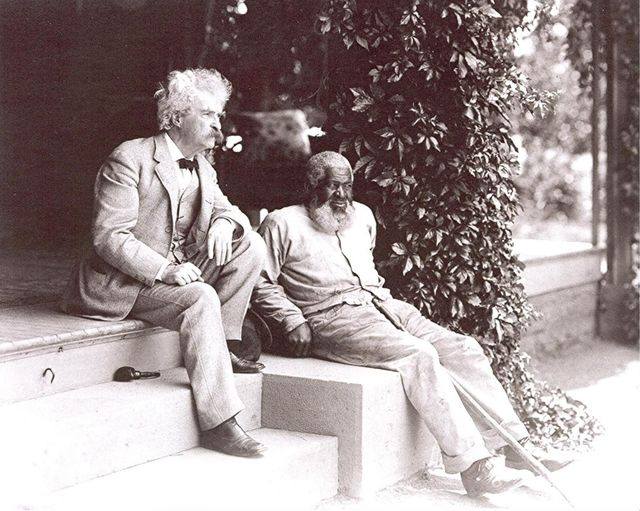
“Huck and Jim in Their Final Years”
He lost everything at 60. Then he did something no bankrupt millionaire had ever done.
Mark Twain—America's most beloved writer, the creator of Tom Sawyer and Huckleberry Finn—stood in the ruins of his fortune in 1894. The mansion, the fame, the comfortable life built on literary genius: all of it was collapsing.
The culprit? An obsession with a machine.
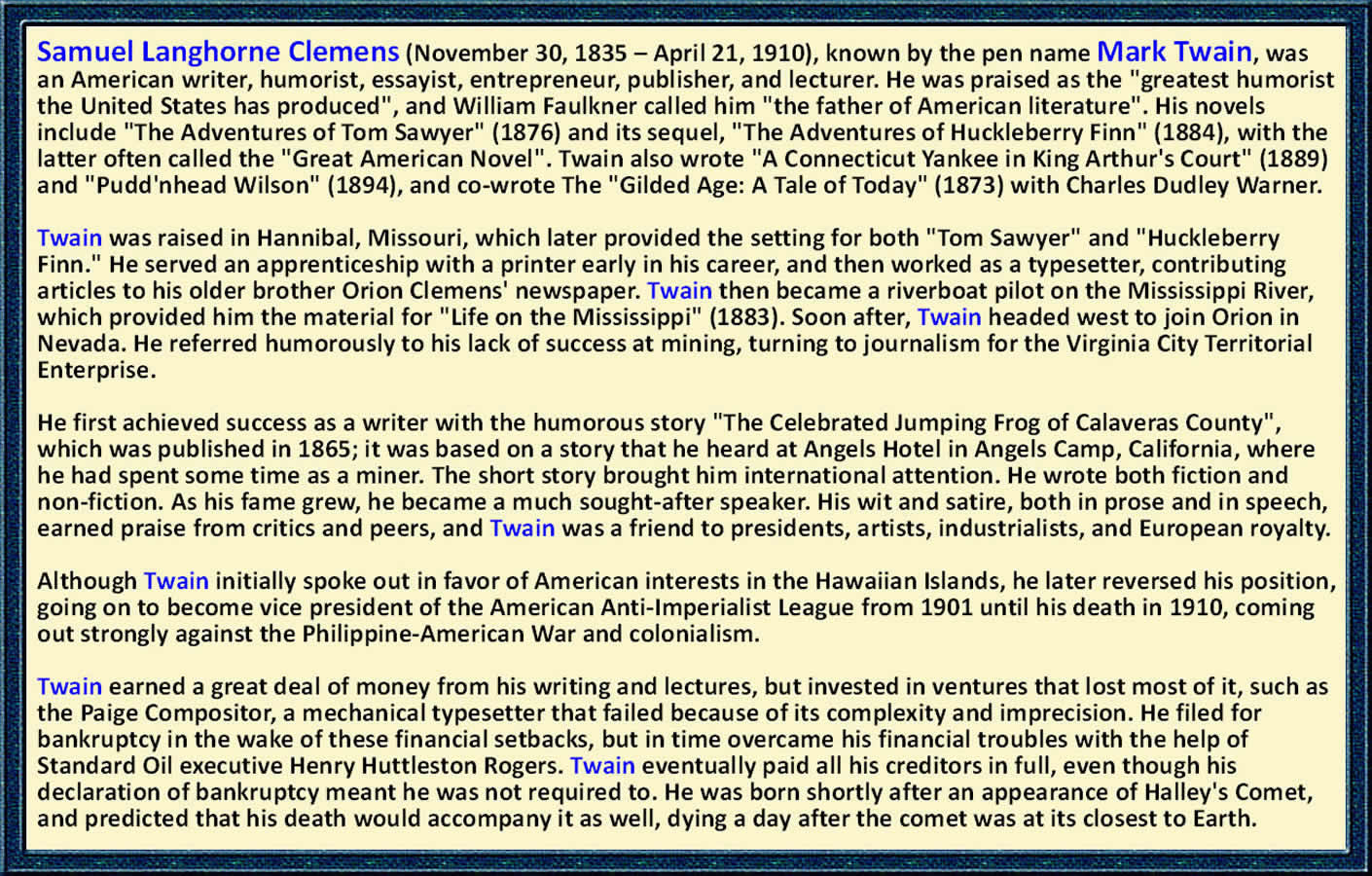
In 1880, Twain met James Paige and his typesetting machine—a mechanical marvel with 18,000 moving parts that promised to revolutionize printing. Twain didn't just see an investment; he saw a path to Rockefeller-level wealth. For 14 years, he poured money into it: $300,000 total, roughly $9 million in today's currency. Every penny he'd earned from his books and lectures went into that machine.
The device was almost perfect. Almost. It kept breaking down—one gear, then another, then another. Meanwhile, a simpler machine called the Linotype quietly conquered the market. By 1894, Twain's publishing company collapsed. At 59 years old, he owed creditors over $100,000 (about $3 million today).
The man who'd satirized American greed and foolishness had gambled everything and lost.
Here's where the story becomes extraordinary.
Most wealthy people facing bankruptcy would declare legal insolvency and walk away. It was standard practice, perfectly legal, entirely expected. The law would protect them.
Twain refused. "Honor is a harder master than the law," he declared. He would repay every single creditor himself, in full.
So at sixty years old—exhausted, grieving the recent death of his daughter Susy from meningitis, carrying the weight of spectacular failure—Mark Twain embarked on a grueling world lecture tour. He traveled to Australia, New Zealand, India, South Africa. Anywhere people would pay to hear Mark Twain make them laugh.
And he was brilliant. Night after night, audiences roared at his stories about jumping frogs and ridiculous tourists and the absurdities of human nature. They never saw the man backstage: coughing from decades of cigar smoking, mourning his daughter, dreading another performance where he had to embody joy he didn't feel.
But he did it. For four years, he performed and wrote and sent every dollar back to creditors.
By 1898, he'd repaid the entire debt.
What most people don't know about Mark Twain is how radical he was beneath the humor. Born Samuel Clemens in 1835—the same year Halley's Comet blazed across the sky—he built his career on making people laugh. But behind the white suits and genial wit was a man furious at injustice.
He joined the Anti-Imperialist League, opposing America's conquest of the Philippines. When U.S. troops massacred civilians during the Philippine-American War, Twain wrote scathing essays comparing American soldiers to medieval crusaders: "We have gone there to conquer, not to redeem."
He wrote against lynching, condemned mob violence against Black Americans, supported women's suffrage, and criticized Christian missionaries abroad. These weren't popular positions. Newspapers attacked him. Friends distanced themselves. But Twain refused to stay silent.
His personal life was marked by tragedy. He married Olivia Langdon, a refined woman who loved him deeply. They had four children. Three of them died before he did: Langdon at 19 months, Susy at 24, Jean at 29. Only Clara survived him.
When Olivia died in 1904, Twain was shattered. "The logic of my position is that I am in the wrong place," he wrote. He believed he should have died first—that she shouldn't have had to live without him, and worse, that he now had to live without her.
His final years were dark. He wrote bitter philosophy about human cruelty, knowing it wouldn't be published in his lifetime. Yet he kept performing, kept wearing the white suit, kept making people laugh.
"The secret source of humor is not joy but sorrow," he once wrote. "There is no humor in heaven."
In 1909, Twain made an eerie prediction: "I came in with Halley's Comet in 1835. It is coming again next year, and I expect to go out with it."
On April 21, 1910—one day after Halley's Comet reached its brightest point—Mark Twain died.
He'd gambled his fortune on a machine and lost everything. But his real invention wasn't mechanical—it was literary. He created the authentic American voice: irreverent, funny, furious at injustice, suspicious of authority, haunted by the gap between what America claims to be and what it actually does.
That voice still matters. Huckleberry Finn is still taught because Huck's moral crisis—choosing to help Jim escape slavery even though society says it's wrong—captures the defining American question: When law and conscience conflict, which do you follow?
Twain chose conscience. Even when it cost him everything.
He buried three children, lost the woman he loved, and spent his fortune chasing progress. Yet he found the strength to repay every debt, speak against empire when silence would've been easier, and keep asking uncomfortable questions until his final breath.
"Whenever you find yourself on the side of the majority," he wrote, "it is time to pause and reflect."
The comet came. He came with it. Seventy-five years later, the comet returned. And precisely as he predicted, Mark Twain went out with it—a gambler who lost everything except his voice.
That voice still speaks. Still challenges. Still refuses to be comfortable.
Just as he intended. |