|
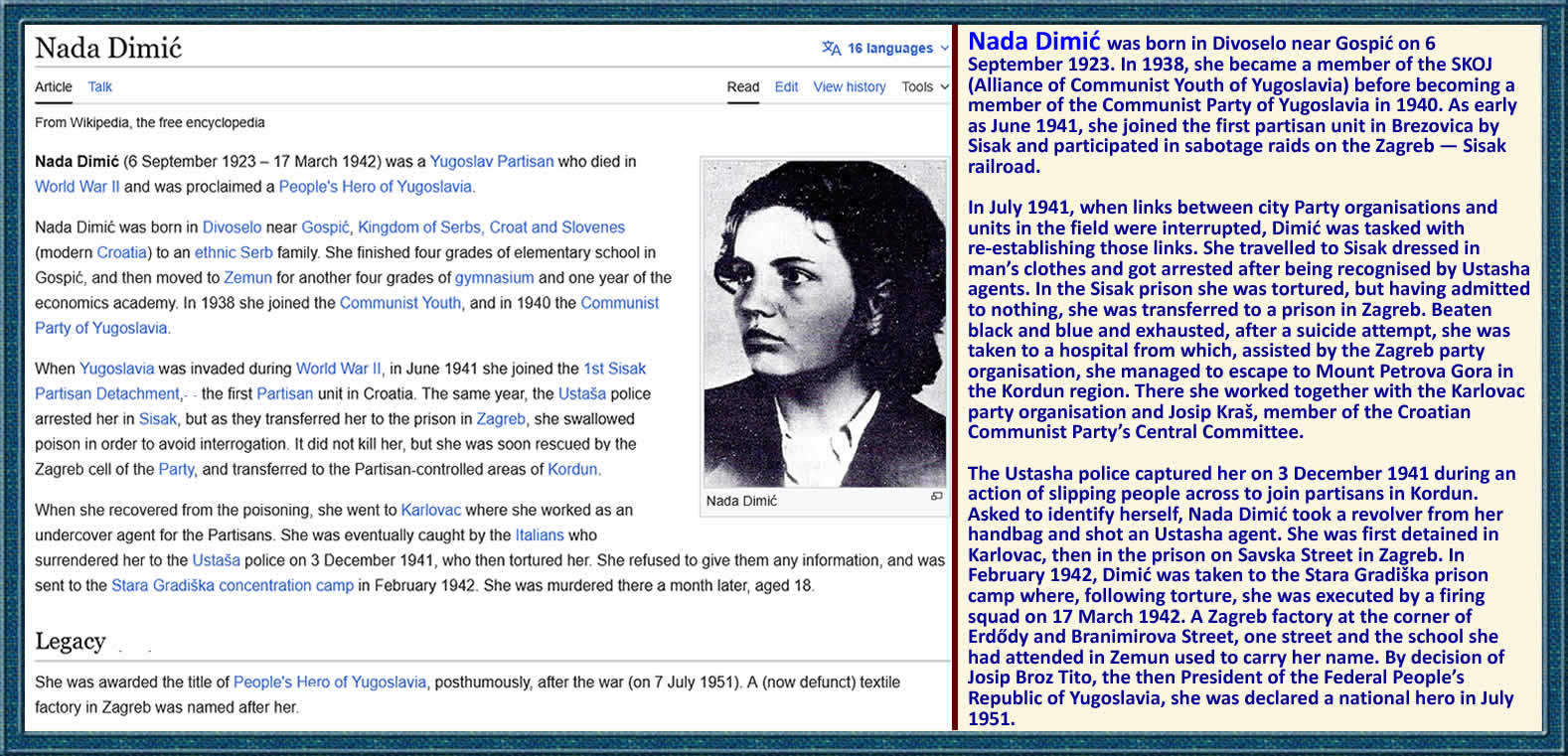
She refused the blindfold. On March 17, 1942, a young woman stood before a firing squad at the Stara Gradiška concentration camp in occupied Yugoslavia. Her body had endured months of torture, and her face bore the raw evidence of what her captors had tried to do to her spirit. Yet, when they offered her a blindfold, she looked directly at the rifles and said "No." Her name was Nada Dimic. She was eighteen years old. Born to a Serbian family in Croatia, Nada had joined the very first Yugoslav partisan unit—a small, determined group that gathered in a forest near Sisak in June 1941. They formed at a moment when most people were still deciding whether resistance was even possible. She had already made up her mind. She participated in sabotage operations along the Zagreb–Sisak railroad—the kind of dangerous work that required both immense courage and absolute invisibility. Later, when communication between city resistance cells and partisan units broke down, she volunteered to re-establish the links, disguising herself as a man to slip through Ustaše-controlled territory. Eventually, they caught her. In a Sisak prison, she was tortured for days, but she said nothing. During her transfer to Zagreb, she swallowed poison rather than risk breaking under further interrogation. It didn't kill her, but it landed her in a hospital, where the Zagreb resistance cell managed to rescue her and bring her back to partisan-controlled territory. She wasn't finished yet. By late 1941, she was working as an undercover agent in Karlovac. When Italian forces moved to detain her, she fought back and fired her weapon, killing one agent and wounding another. Captured again, she was handed over to the Ustaše. What followed was the systematic brutality of people determined to extract everything she knew: names, safe houses, operations, and the people she had fought alongside. She gave them absolutely nothing: not one name, not one location, not a single word that could unravel the network she had given everything to protect. In February 1942, she was transferred to the Stara Gradiška concentration camp. A month later, they executed her. She was still only eighteen years old. In July 1951, Yugoslavia declared Nada Dimic a People's Hero—one of the highest honors the nation could bestow. The recognition arrived nine years too late for her to ever hear it, but something the bullets could not touch had already survived: her example. It was passed quietly from person to person, generation to generation—a stark reminder that courage is not always loud, visible, or recorded. Sometimes, courage looks like silence when silence is the only weapon you have left. Sometimes, it looks like an eighteen-year-old standing straight, eyes wide open, refusing to let them take even that final, small piece of her dignity. Courage isn't the absence of fear. It's knowing exactly what is coming—and choosing, one last time, exactly who you are. Remember her name: Nada Dimic. |