 |
 |
|
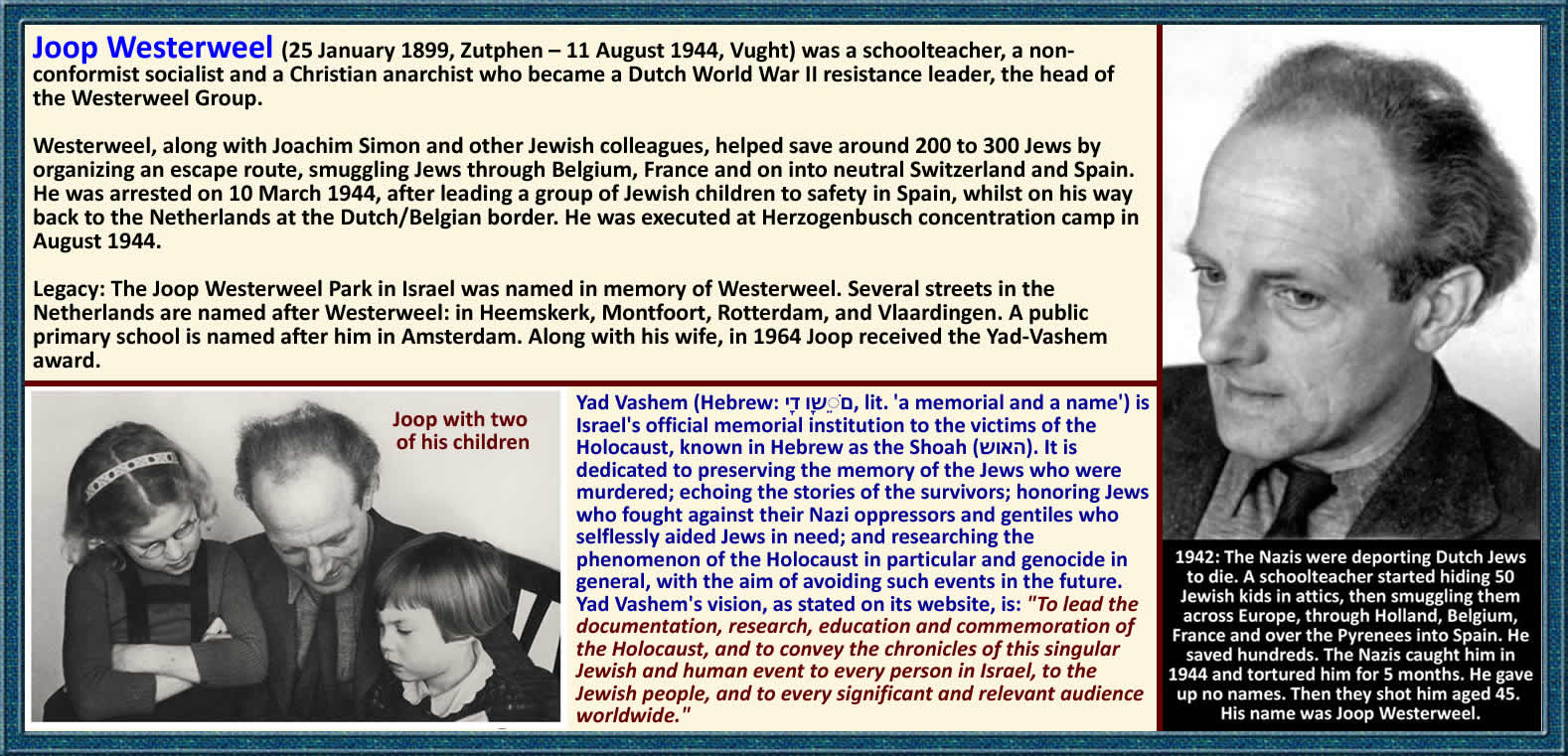
1942 Rotterdam, Netherlands: Joop Westerweel was 43 when a friend asked him to hide some Jewish kids.
He was a schoolteacher, a Christian and a pacifist with four kids of his own at home.
The friend was a Jewish teacher named Mirjam Waterman.
She told him about Loosdrecht: a Jewish training farm near Amsterdam. 50 young people aged 15 to 19 lived there, refugees from Germany and Poland. They were preparing to emigrate to Palestine after the war.
The Nazis had just put all 50 of them on the deportation list.
She asked Joop if he could hide them.
He thought about his wife, his four kids, the death penalty for hiding Jews - and he said "Yes."
He had two days. On the night of August 16, 1942, German trucks came for the 50 kids. The farm was empty. All 50 had been smuggled into hiding the night before: stars off their coats, false papers in their pockets, scattered across the country. 33 of them would survive the war. That was just the start. Here's how he got there. Joop Westerweel was born in 1899 into a strict Christian family. His parents belonged to a small Protestant sect called the Derbists. He grew up a pacifist, a Christian anarchist who believed in non-violence. He got a teaching job in the Dutch East Indies, but was expelled when he refused the army draft. He wouldn't carry a rifle for anyone. He came home and married a woman named Wil, with whom he had four children. He became principal of a Montessori school in Rotterdam and lef a quiet life as a teacher with a wife and kids and ideas about education. Then the Germans invaded. May 1940: The Netherlands fell in five days.
By 1942 they were deporting Dutch Jews by the thousands: to Westerbork, then Auschwitz, then Sobibor.
Three out of four Dutch Jews would be murdered: the worst death rate in Western Europe.
Joop started taking Jews into his own house - quietly, one or two at a time.
Then Mirjam came to him about the Loosdrecht 50. The first escapes happened in December 1942. Shushu led them himself. On one of the trips in early 1943, he got arrested at the Dutch-Belgian border. He got a message to the group from his cell. He'd been caught. They couldn't trust him to hold up under torture. A few days later he killed himself. He was in his twenties: died to protect his comrades. The group nearly fell apart, but Joop took over and expanded the group to about 20 people: Christians, Jews, socialists and Zionists. They became known as the Westerweel Group. For the next year they ran the escape route themselves. They moved Jewish kids from Amsterdam south: Brussels, Paris, Lyon, down to the Pyrenees. French resistance fighters took them over the mountains. Joop made the trips himself multiple times. He guided groups of teenagers across hundreds of miles of Nazi-occupied Europe. December 1943: He led a group to the foot of the Pyrenees. Before he turned back, he gave them a speech.
He told them when they built their new country, remember the suffering of the world. Give freedom to everyone who lives there. Don't be just another nation that excludes.
Then he walked back into occupied France.
Same month. December 1943. His wife Wil was arrested. She had tried to break a Jewish woman out of a Dutch prison.
Joop put his four kids into hiding, quit his job, went underground - and kept escorting groups.
A friend once thanked him for saving Jewish lives.
Joop corrected him. On March 11, 1944, Joop and his partner Bouke Koning were caught at the Dutch-Belgian border. They had two Jewish women with them. They were taken to Vught concentration camp. The Nazis tortured Joop for five months: they wanted names, routes, contacts. He gave them nothing: not a name, not an address, not a single contact. He wrote a poem in his cell in July. He called it "Evening in the Cell." It was about the light inside him that the Nazis couldn't reach. On August 11, 1944, they took him outside and shot him. He was 45. His wife Wil was being held in the same camp. After his execution she was sent to Ravensbrück, but she survived and came home in 1945 to be reunited with their four children. The Westerweel Group kept running until liberation. They saved between 150 and 300 Jewish lives, mostly young pioneers who reached Palestine and helped build Israel. In 1963, Yad Vashem named Joop and Wil Righteous Among the Nations. Survivors planted a forest in Israel in his honor: The Westerweel Forest - still standing. His daughter Marta later moved to Israel. She had been three when he was arrested, five when he died. She had no memory of him. The survivors told her stories - stories she had never heard. She later said: "In the Netherlands I was a fatherless child. Here in Israel I became my father's daughter." Here's what makes this story matter.
Joop had four reasons not to do any of this: his wife. his four kids, his pacifism, his job. |