 |
 |
|
October 9, 1974. When the ambulance arrived, it was already too late.
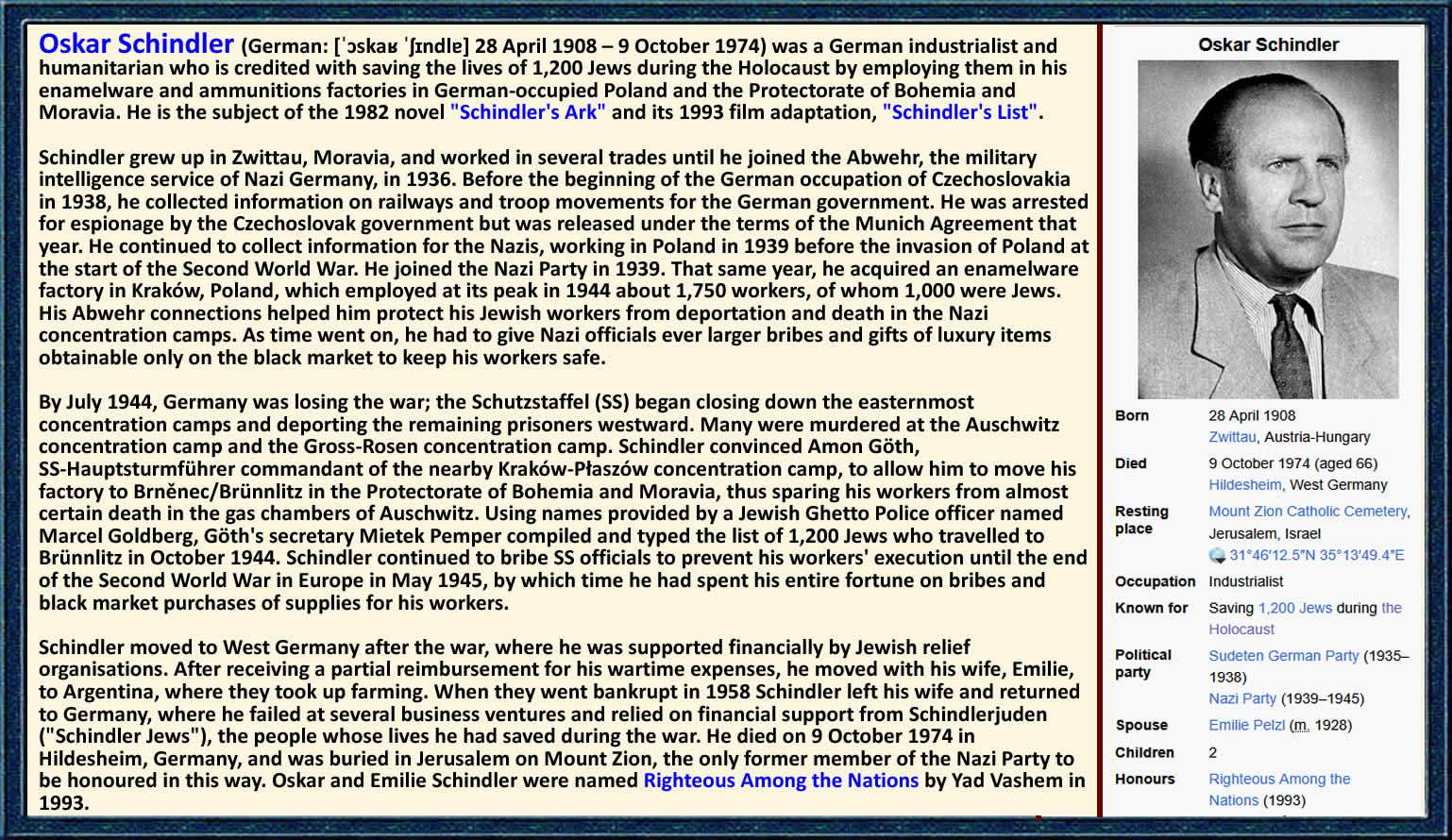
A 66-year-old man collapsed on a street in Hildesheim, West Germany: heart failure. When authorities entered his Frankfurt apartment afterward, they found almost nothing — no savings, no assets, just unpaid bills and a stack of letters from Israel.
Every letter contained money.
The man's name was Oskar Schindler, and the people sending him money were the same people he had once risked his life to save.
But here's what the famous movie doesn't tell you about him. Schindler was not a good man when the war began. He was a Nazi Party member, a spy for German military intelligence, a womanizer, a drunk amd an opportunist who saw the German invasion of Poland in 1939 as a business opportunity. Within weeks of arriving in Kraków, he had taken over a formerly Jewish-owned enamelware factory through Nazi "Aryanization" policies. He employed Jews from the ghetto because they were essentially free labor. He drank with SS officers. He bribed officials. He dealt on the black market — not to save lives, but to get rich. And he did get rich. The change didn't come from ideology or religion or sudden enlightenment. It came from a hill. In March 1943, Schindler watched on horseback from a ridge above Kraków as the SS liquidated the ghetto below. He watched soldiers drag children from their parents. He watched people shot in the streets. He watched a little girl in a red coat walking alone through the chaos — unhurried, as if she hadn't yet understood what was happening around her. Something in him broke. Or maybe something finally woke up. "I had to help," he said later. "I had no choice." From that point, Schindler began spending his fortune — the same fortune he'd built off cheap Jewish labor — to keep those same people alive. He bribed Nazi commandants with cash, jewelry, and liquor. He built a subcamp attached to his factory so his workers wouldn't have to return to the brutality of Plaszów, where SS-Hauptsturmführer Amon Göth shot prisoners at random from his villa balcony for amusement. He bought food on the black market. He paid for medicine. He argued, manipulated, and deceived every official he could. When the SS announced his factory would be shut down and his workers sent to Auschwitz, Schindler compiled a list of 1,200 names — men, women, children, the elderly — and declared them all "essential munitions workers." It was a lie, but one that saved many innocent llives. He moved the entire operation to Brünnlitz in Czechoslovakia. The men arrived safely, but the women's train was mistakenly routed to Auschwitz. Schindler went there personally. He bribed his way past the gates and negotiated their release. He brought them all back. At the Brünnlitz factory, his workers deliberately produced defective ammunition — shells and casings that couldn't be used. Schindler covered the shortfall by buying working munitions on the black market and presenting them as factory output to the Armaments Ministry. He was simultaneously running a functioning business and a full-scale rescue operation. He spent every pfennig he had. And then there was Emilie. History has never given Schindler's wife the credit she deserves. In January 1945, a sealed cattle car arrived at Brünnlitz — 120 Jewish men from a subcamp of Auschwitz, locked inside without food or water for seven days in freezing temperatures. Thirteen had already died. The SS wanted the survivors sent back for extermination. Emilie Schindler refused. She and Oskar convinced the commandant they were needed as workers. Then Emilie personally nursed the 107 survivors back to health — feeding them by hand, dressing their wounds, sitting with the ones who might not make it through the night. When the war ended in May 1945, Schindler gathered his workers together. "The war is over," he told them. "You are free." Then he fled — because as a former Nazi official, he faced arrest in Czechoslovakia. A group of Schindlerjuden wrote him a letter of testimony to carry with him. He left with nothing but that letter and the clothes on his back. What followed was a long, quiet unraveling. Argentina: a nutria fur farm that went bankrupt; a cement factory in Germany that collapsed; a marriage that dissolved. A man who had once bent the machinery of the Third Reich to his will was now unable to hold together a single business venture. By 1961, Schindler was broke and living in a small Frankfurt apartment, surviving on the goodwill of others. That year, he visited Israel. The Schindlerjuden gave him a reception he hadn't earned in any boardroom or business deal. They embraced him. They celebrated him. They wept with him. And then — quietly, month after month — they began sending money. Not as charity. As a debt they insisted on repaying. For thirteen years, the people on Schindler's list paid his rent, bought his food, and kept him alive — the same way he had once kept them alive. When he died in 1974, they arranged his funeral. And they buried him exactly where he had asked to be buried: not Frankfurt, not Kraków but Jerusalem. Hundreds of Schindlerjuden followed his coffin through the ancient streets of the Old City to the Latin cemetery on Mount Zion. One survivor pressed a handwritten note into the stone: "The unforgettable rescuer of 1,200 persecuted Jews." |