|
Bishop Michal Kozal lay in the Dachau sick ward, burning with typhus.
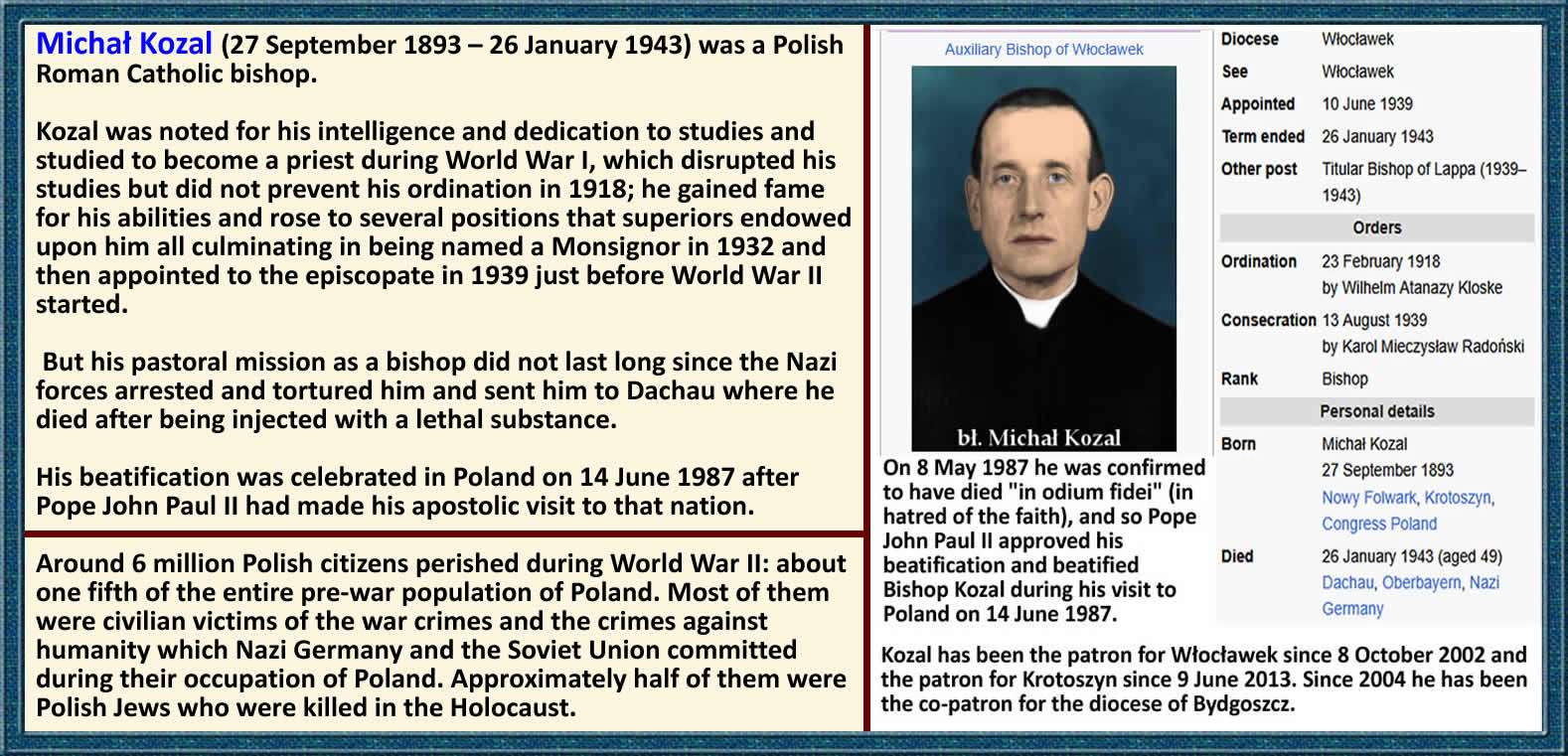
January 26, 1943. He was 49 years old: Polish, a Catholic bishop - and prisoner number 24544.
Three men walked toward his bed: two SS officers, one in a white doctor's coat.
They stopped, compared papers. The doctor asked his name. "I am Michal Kozal." "Are you a bishop?" "I am a Roman Catholic bishop." The doctor pulled out a syringe filled with phenol: pure poison. In the next bed was Kozal's cousin, Father Ceslao Kozal: also a prisoner, also a priest. He watched, but couldn't stop it. The doctor injected the bishop's right arm. Said quietly: "Now the way to eternity will be easier." Five minutes later, the doctor said one more word. "Fertig." Finished. Father Ceslao had already given his cousin last rites: silently, under a blanket. The Dachau records said: "Died of heart failure caused by typhus." A lie, like everything else. Here's how he got there. In 1893 Michal Kozal was born in Nowy Folwark, a tiny Polish village - into a peasant family with nine children sand no money to to educate them all. But Michal was smart, serious, devout. At 12, he told his parents he wanted to be a priest. His parents scraped together money for school. He attended a Polish gymnasium under Russian occupation: participated in a student strike against forced Germanization. The Germans tried to erase Polish identity, but Michal fought back - even as a boy. He entered seminary in Poznan. World War I interrupted his studies, but he was eventually ordained a priest in February 1918 in Gniezno Cathedral. For the next 20 years, he served parishes across Poland: taught at seminaries, became rector of the Major Seminary at Gniezno and named Monsignor in 1932. He was known for one thing above all: dedication to his students, to the poor, to the Church. In June 1939 Pope Pius XII appointed him auxiliary bishop of Wloclawek, and on August 13, 1939.he was consecrated bishop in Wloclawek Cathedral. Three weeks later, the Germans invaded Poland and WWII had begun and Nazi troops poured across the border. The Polish bishop of Wloclawek fled the city. Kozal was now in charge. He had a chance to escape, too. Polish authorities begged him to leave. Other bishops offered him safe passage. He refused. "I stay with my people." And he did something else, something that would change history. His secretary was a young priest: 38 years old, brilliant. outspoken. The Gestapo already had his name. He'd written articles criticizing Nazi ideology. The priest was Stefan Wyszynski. Kozal ordered him to leave Wloclawek immediately, to go into hiding and disappear. Wyszynski obeyed: fled to Warsaw, then into the forests, where he survived the war in hiding. Later, Wyszynski would become Cardinal: Primate of Poland and spiritual leader of the Polish nation, one of the most important Catholic figures of the 20th century - and mentor to Karol Wojtyla, the future Pope John Paul II. Kozal saved his life by sending him away - but Kozal stayed. On September 14, 1939. German troops entered Wloclawek and began dismantling the Church systematically: Catholic publications shut down, churches confiscated, schools closed, priests arrested. Kozal protested to the occupation authorities - demanded they respect Church property and release imprisoned priests. They laughed at him. On November 7, 1939 the Gestapo came for Bishop Kozal. They arrested him along with 44 other priests and seminarians. He was thrown into the local prison: beaten, interrogated. In January 1940 he was transferred to a Cistercian convent that had been turned into a concentration camp and held there for over a year.. He suffered frostbite on his ears and nose during the winter transfer. In
April 1941 he was moved to Inowroclaw: more beatings, more interrogations. His ear was severely damaged from torture.
Three weeks later, he arrived at Dachau: Other priests described him as "the soul of the block." - a man who never lost hope, never stopped believing.
For nearly two years, he ministered inside Dachau - under daily torture, with almost no food, with his body breaking down.
Then the typhus epidemic came.
It swept through Dachau in late 1942. Thousands of prisoners were infected. The SS panicked. They didn't want the disease spreading to guards.
Kozal caught typhus in January 1943. His condition worsened rapidly. On The war ended two years later. Of the priests who entered Dachau with Kozal, most were dead.
1,811 Polish priests died in Nazi concentration camps. 220 from the Wloclawek diocese alone.
Kozal's story survived because of witnesses: his cousin, fellow prisoners. priests who'd escaped death by days or weeks.
They told what they'd seen: the beatings, the Mass in the barracks, the final injection. In
1960 Pope John XXIII opened the beatification process. Kozal was declared "Servant of God." Kozal's single act of sending Wyszynski away had shaped Polish history, had saved the man who would save Polish Catholicism through 40 years of Communist rule.
Today, a stone monument stands in Wloclawek Cathedral. It honors Bishop Michal Kozal and 220 other priests of the diocese who died in Dachau.
The Kozal family in America keeps a small relic. A piece of his cassock. It's the only physical thing left of him.
Everything else was burned.
Here's what makes his story so important. Bishop Michal Kozal - 49 years old, murdered by a "doctor" with phenol in a Dachau sick ward, cremated without ceremony. His legacy? A single line remembered by his cousin from the next hospital bed: "I am a Roman Catholic bishop."
The last words of a man who refused to be anything else.
|