 |
 |
|
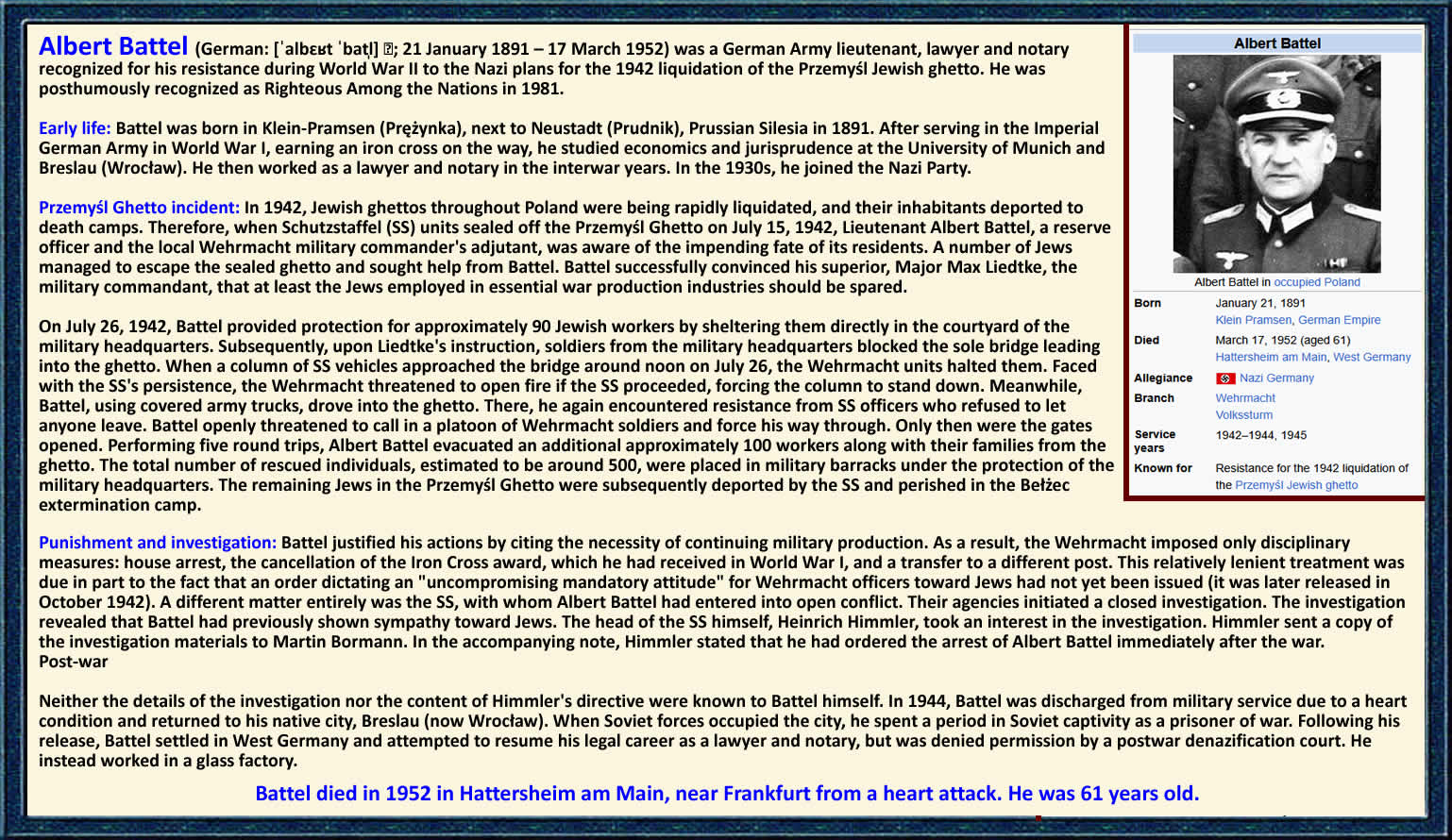
In July 1942, the SS was ready to "liquidate" the Jewish ghetto. Trucks were waiting to take men, women, and children Battel was a Wehrmacht officer, a member of the regular German army. He wasn't a rebel or a young hothead. He was a middle-aged man who had practiced law before the war. But when he saw the SS convoy roaring toward the bridge over the River San - the only entrance to the ghetto - he decided he had seen enough. Battel ordered his soldiers to lower the bridge barrier. When the SS commander pulled up and demanded to pass, Battel didn't flinch. He told the commander he was not allowed to enter. The SS officer was stunned. He threatened Battel with severe consequences, but Battel didn't back down. Instead, he played a card that could have gotten him executed on the spot. He turned to his own men and gave a chilling order. "If they try to cross this bridge, open fire," he told his machine-gunners. It was a moment of total, terrifying silence. German soldiers were now aiming their weapons directly at German police. The SS commander, seeing that Battel was dead serious, finally blinked. He ordered his trucks to turn around and leave. But Battel knew the clock was ticking. The SS would be back with more men and higher orders. He didn't waste a single second. He took his own military trucks and drove them straight into the Jewish ghetto. He didn't go there to arrest people. He went there to rescue them. He knocked on doors and told terrified families to grab what they could. Using a clever loophole, he claimed these people were "essential workers" for the war effort. "Get in the trucks! Move quickly!" he urged them. He managed to load up nearly 100 families. He drove them out of the ghetto and hid them inside the local military barracks under the protection of the army. Word of this defiance went all the way to the top. Heinrich Himmler, the head of the SS, was livid. He personally looked into the case and wrote a dark note in Battel’s file. He promised that as soon as the war was over, Battel would be arrested, kicked out of the party, and "dealt with."
Battel was eventually pushed out of the military due to heart issues. When the war ended, he lived a quiet, forgotten life in West Germany and died in 1952. He never bragged. He never wrote a book. He just went back to being a lawyer.
"Righteous Among the Nations"by Yad Vashem. In a world of total darkness, your conscience is the only light that matters. We often say: "I was just following orders" to excuse our silence, but Albert Battel proved that even in a system built on fear, you always have a choice. Doing what is right is rarely easy, and it is often dangerous, but it is the only thing that keeps us human. |