 |
 |
 |
| She was 21 years old. She spoke flawless German.
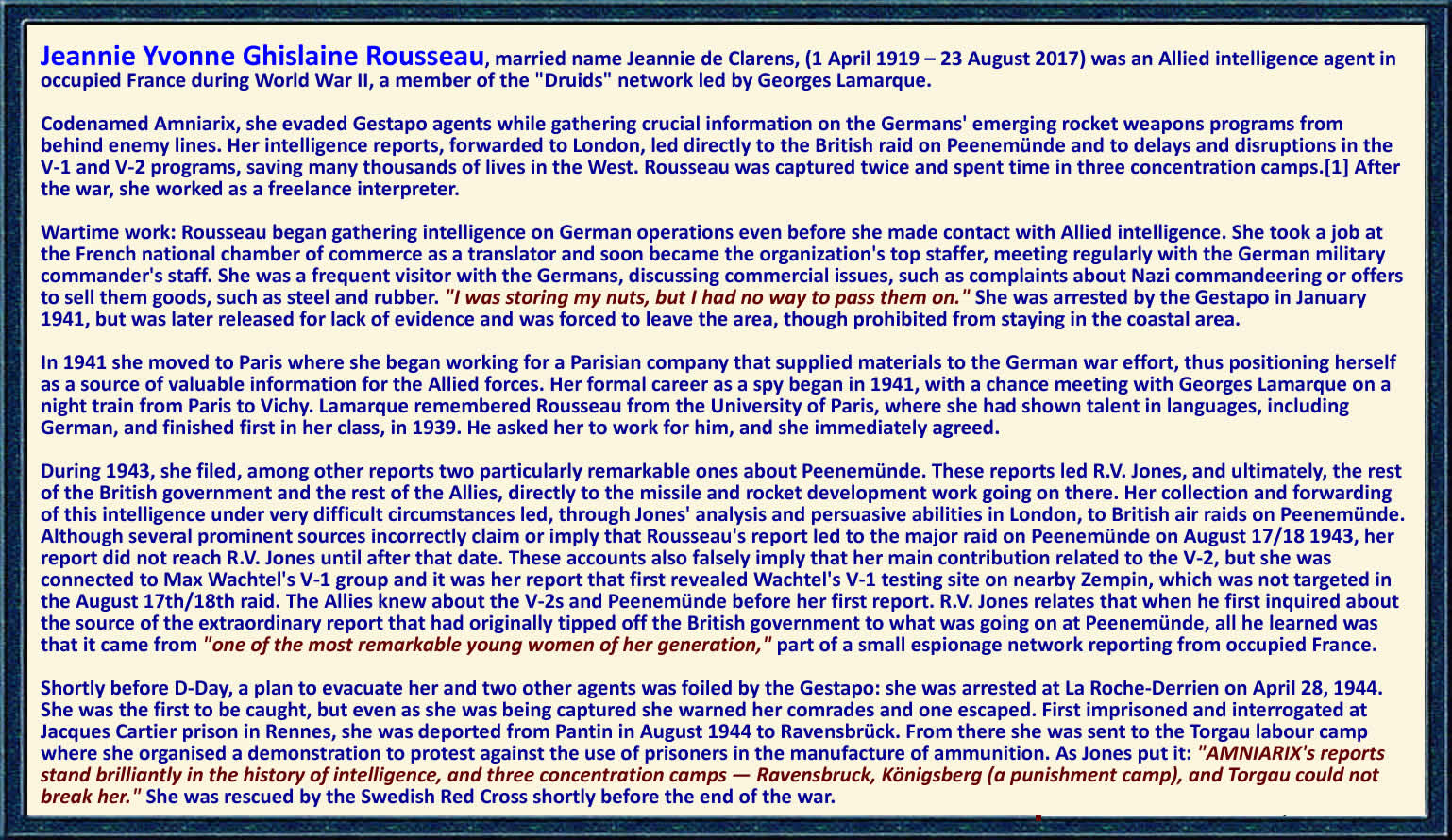
And she had a memory that worked like a camera. In 1940, when Nazi forces swept across France, most people kept their heads down and tried to survive. Jeannie Rousseau chose a different path. Her father, a former French foreign ministry official, put her forward to work as an interpreter for German officers in Brittany. She was young, elegant, and warm — exactly the kind of woman powerful men underestimate. So they talked freely around her. And Jeannie listened to every word. She began passing what she heard to the French Resistance. When the Gestapo grew suspicious and ordered her out of the coastal region, she didn't go into hiding. She went to Paris. And got another job as a translator. This time, she worked for French industrialists dealing with German military leadership. Then one night in 1941, on a train from Paris to Vichy, she ran into an old university classmate — Georges Lamarque. He remembered her: she had finished first in her class, with an extraordinary gift for languages. He asked her to join his intelligence network, known as the Druids. She agreed without hesitation. Her codename: Amniarix. Her method was almost too simple. She listened. She asked innocent questions. And when German officers began talking about a terrifying new weapon — rockets that could fly hundreds of miles and rain terror on enemy cities — she did something brilliant. She pretended not to believe them. "That can't possibly be real," she told them, widening her eyes. "You're exaggerating." They pushed back. She kept doubting. Over and over, she played the skeptic. And it worked. One officer, determined to convince her, showed her technical sketches — dimensions, figures, details of the testing program. Jeannie had no engineering background. But she had that extraordinary memory. She absorbed everything: the numbers, the layout, the location of the facility on the Baltic coast. That night, she wrote it all down. Word for word. Her reports made their way to British intelligence analyst R.V. Jones in London. When he asked who the source was, he was told only that it came from "one of the most remarkable young women of her generation." Her intelligence on the V-1 flying bomb program — particularly the previously unknown testing site at Zempin — proved critical. It helped the Allies understand the full scope of Germany's rocket program and contributed directly to raids that disrupted production and testing, saving thousands of lives. She kept working through 1944. But just before D-Day, a plan to evacuate her and two fellow agents was betrayed. The Gestapo arrested her at La Roche-Derrien on April 28, 1944. Even as she was being seized, she managed to warn her companions. One escaped. They sent her to Ravensbrück. Then to Königsberg — a punishment camp. Then to Torgau. Through it all — the interrogations, the starvation, the tuberculosis — she never broke. She never revealed what she had done or what she knew. When the Swedish Red Cross liberated her in 1945, she was barely alive. She recovered in a Swedish sanatorium, where she met Henri de Clarens, a survivor of both Buchenwald and Auschwitz. They married and had two children. After the war, she worked quietly as a freelance interpreter for the United Nations. For decades, almost no one knew her story. She avoided reporters. She avoided historians. She received France's Legion of Honor in 1955 and the CIA's Agency Seal Medal in 1993, but gave almost no interviews. It wasn't until 1998 that journalist David Ignatius of the Washington Post finally got her to open up. He asked why she had done it — why she had risked everything when others stayed silent. She seemed almost puzzled. "I just did it, that's all," she said. "It wasn't a choice. It was what you did." Later, reflecting on her role in the war, she was characteristically modest. "What I did was so little," she said. "Others did so much more. I was one small stone." But that small stone — a 21-year-old woman with a flawless memory and a talent for pretending not to understand — helped stop one of history's most terrifying weapons programs. She died on August 23, 2017. She was 98 years old. Most people have never heard her name. Now you have. |