 |
 |
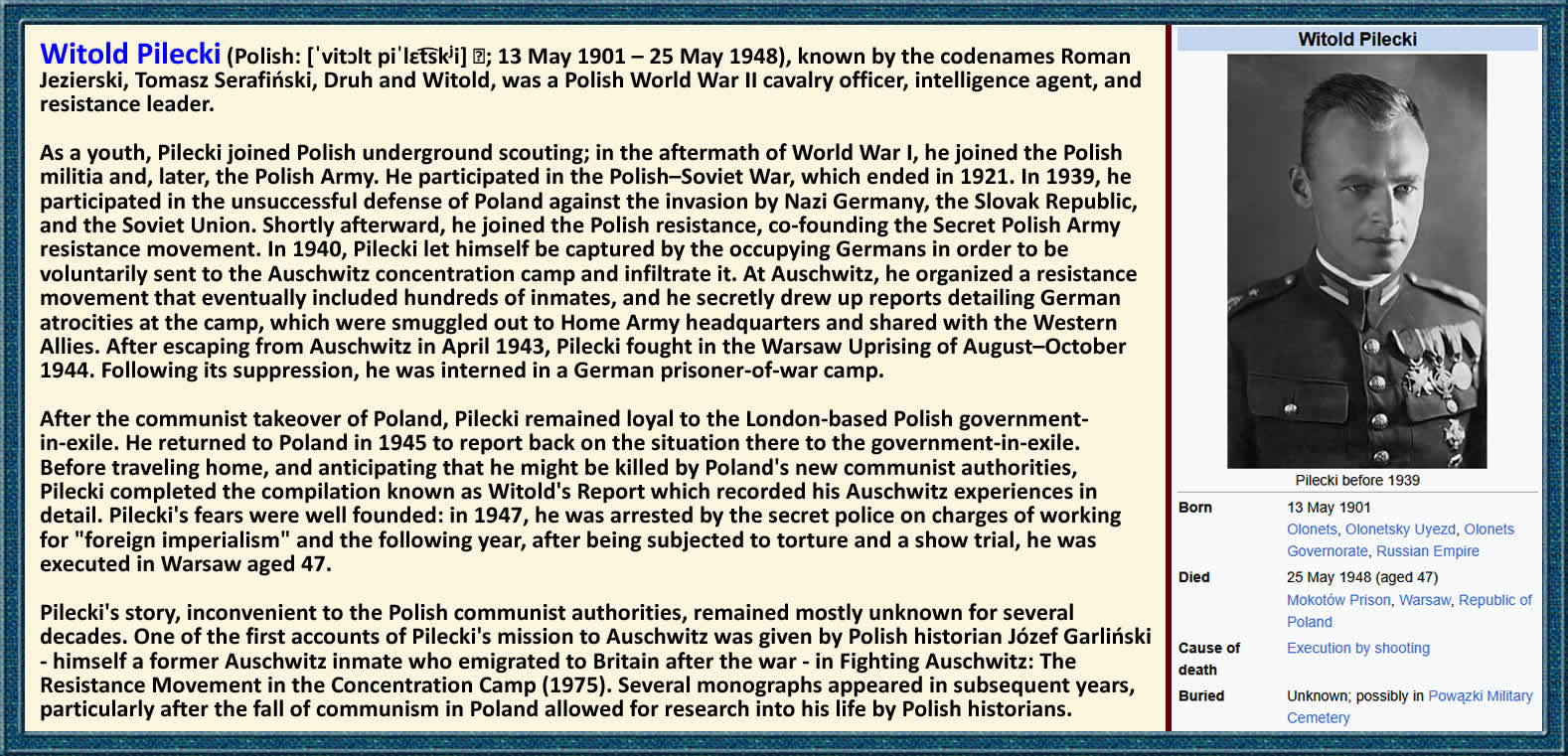
| On the morning of September 19, 1940, a 39-year-old Polish cavalry officer walked into a street in central Warsaw and waited to be arrested.
He was not running from the Germans: he was walking toward them.
The Gestapo was conducting a lapanka — a street round-up. Soldiers blocked off the area, and anyone caught inside was loaded into trucks and sent east, to a new concentration camp the Germans had recently opened in a former Polish artillery barracks.
The camp was called Auschwitz.
Witold Pilecki had volunteered to go inside.
He was an officer of the Polish underground resistance. His commanders had a question they needed answered: what was actually happening at Auschwitz? Rumors had begun reaching Warsaw. Prisoners were going in. Almost none were coming out. The Germans were building something there.
The Polish underground needed a man on the inside.
Pilecki raised his hand. Pilecki composed the first detailed eyewitness reports of what was happening inside Auschwitz. He described the gas chambers as they were being built. He described the mass executions. He described the medical experiments. The reports were smuggled out by prisoners who were released or escaped, hidden in laundry, in bread, in the linings of coats. They reached the Polish government-in-exile in London, which forwarded them to the British and the Americans. The Allies received them. They read them. They did almost nothing. Pilecki kept writing. He kept organizing. He survived a bout of pneumonia that killed most of the men in his barrack. He survived the camp's first typhus epidemic. He saw his closest friends shot, hanged, gassed, or worked to death in front of him. By April 1943, he had been inside for two years and seven months. The Germans had begun executing members of his network. The Allies were not coming. He decided his most useful service to the resistance was now on the outside. On the night of April 26, 1943, working in a bakery just outside the main camp, he and two other prisoners overpowered a guard, cut a telephone line, and ran into the dark.
He walked, in stolen clothes, for seven days. He reached the safety of the Polish underground.
He delivered his full report in person.
He fought in the Warsaw Uprising of 1944 as an ordinary soldier — without telling his comrades that he had once been prisoner 4859. He was captured by the Germans when the uprising fell, and held in a POW camp until liberated by American forces in 1945.
The war was over.
For Witold Pilecki, the dying was not. He returned to Poland in late 1945, again under a false name, to do for the Soviet occupation what he had done for the German one — gather intelligence, document the crimes, send reports out. He was arrested by the Polish Communist secret police on May 8, 1947. They tortured him for six months. His wife, who was permitted one visit, said afterward that he told her quietly: Auschwitz was easier. He was put on a show trial in March 1948. He was charged with espionage on behalf of "foreign imperialism." He was convicted. On May 25, 1948, Witold Pilecki was taken to a prison in Warsaw, shot in the back of the head, and buried in an unmarked grave. He was 47 years old. His grave has never been found. For the next 41 years, his name was forbidden in Poland. His wartime reports were classified. His children grew up knowing only that their father had been a war criminal — because the state had told them so. In 1989, when the Communist regime fell, the records began to open. In 1990, Witold Pilecki was officially exonerated by the Polish government. In 2006, he was posthumously awarded the Order of the White Eagle, Poland's highest civilian decoration. The same medal that had been given to Irena Sendler. In 2013, the British historian Michael Foot wrote that Pilecki was one of "the six bravest men of the resistance in the Second World War." In 2019, his daughter Zofia, aged 86, said in an interview that she still hoped, before she died, to learn where her father was buried. She has not learned. No one has. The twist is not that a Polish officer volunteered to be sent to Auschwitz to gather intelligence on the gas chambers. The twist is this. When Witold Pilecki walked into the lapanka on September 19, 1940, he believed he was doing his duty to a country that would still exist when the war ended. He was right that the country would exist. He was wrong about who would be running it. The Germans tortured him for two and a half years and could not break him. The Poles he came home to fight for shot him in the back of the head and threw his body into a hole that they made sure no one would ever find. His last recorded words, written in his prison cell, were a message to his children: "I have lived my life as I should. I am at peace". |