 |
 |
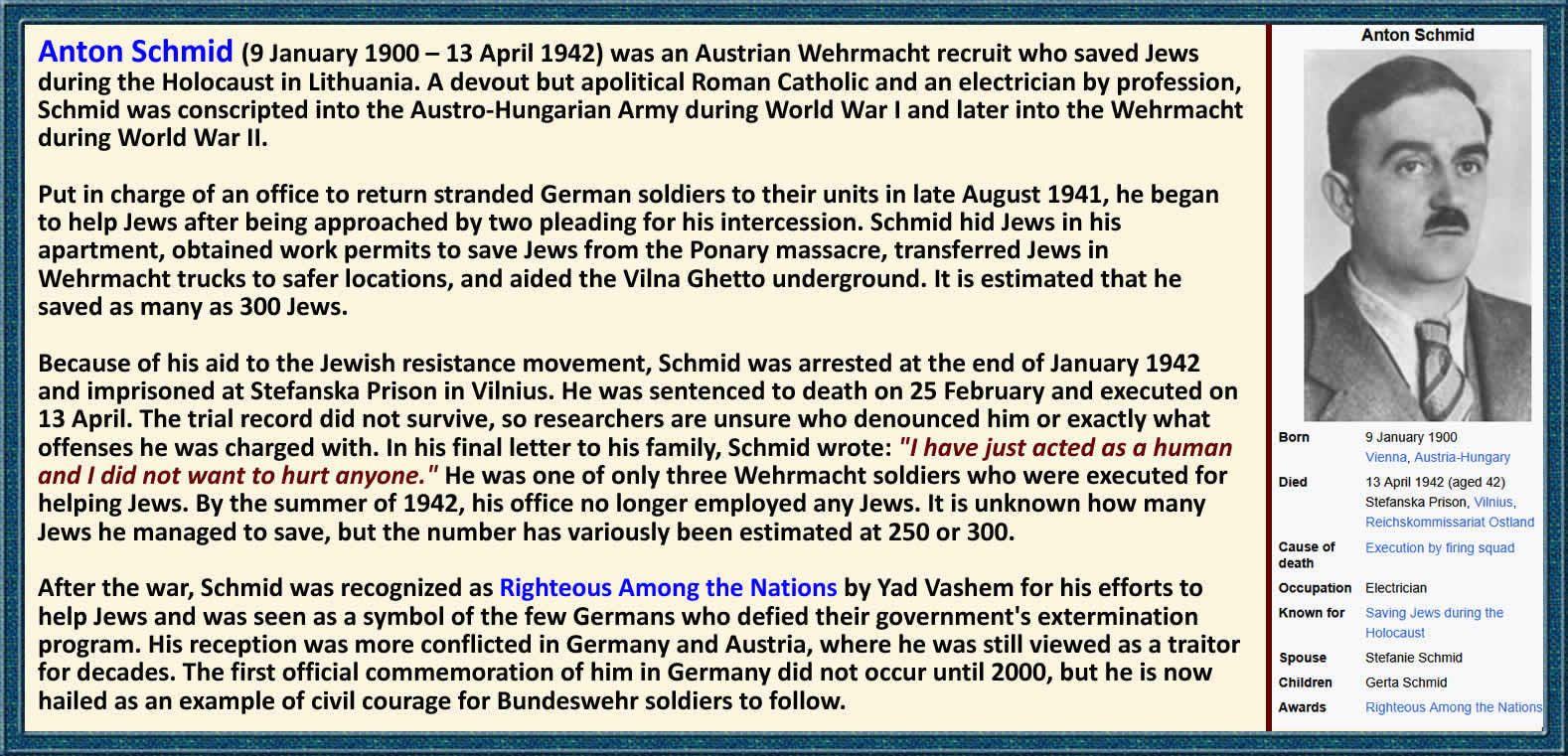
| Anton Schmid ran a small radio shop in Vienna.was before the war. He was a forty-one-year-old electrician,
"socially awkward" people who knew him said. He didn't read books or newspapers; was devoted to his work, his wife Stefanie, his daughter Greta - an ordinary man living an ordinary life in a city just become part of the Third Reich. He was drafted into the Wehrmacht in 1939 - too old for the front lines. He was assigned to run an office near Vilna, Lithuania, that returned stranded German soldiers to their units — a logistical role, behind the lines, far from combat. In the autumn of 1941 he watched the Germans and Lithuanians begin herding Jews to a forest site called Ponary, nine kilometers outside the city. He wrote home to Stefanie: "The Lithuanian military herded many Jews to a meadow outside of town and shot them, each time around two thousand to three thousand people. On their way they killed the children by hurling them against the trees. You can imagine." He could not walk past.
Two Jews came to him first — strangers who had heard he might help - he helped them. Word spread quietly through the ghetto the way word of a safe person always spread — carefully, one person at a time, because the wrong person knowing could get everyone killed.
He began issuing false work permits. The Jews in the ghetto called them "leave from death papers" because a permit fromSchmid's office usually kept the SS from taking the holder. He requisitioned Jews as workers for his office — more than he actually needed, to keep them off the deportation lists. He hid people in his apartment. He obtained forged identity documents and drove people out of Vilna in Wehrmacht military trucks, past German checkpoints, to safer locations in the countryside.
He made contact with the underground resistance fighters in the ghetto — the young men and women organizing what would eventually become the first armed Jewish uprising of the war. He supplied them with forged papers. He brought them weapons when he could find them. He gave them money. Before he died he wrote a final letter to Stefanie.
He told her what he had seen at Ponary. He told her why he had done what he did. And then he wrote: "I have just acted as a human and I did not want to hurt anyone."
He had also told a Jewish resistance fighter, sometime in those last months: "We all must die. But if I can choose whether to die as a murderer or a helper, I choose death as a helper." He was executed by firing squad on April 13, 1942. He was forty-two years old.
When word reached the Vilna Ghetto that he was dead, the Jews there said Kaddish for him — the mourner's prayer, the prayer said for the dead. They said it for a German soldier. Hannah Arendt was in the audience to cover the trial for The New Yorker. She wrote afterward: "During the few minutes it took Kovner to tell of the help that had come from a German sergeant, a hush settled over the courtroom — it was as though the crowd had spontaneously decided to observe the usual two minutes of silence in honor of the man named Anton Schmid. And in those two minutes, which were like a sudden burst of light in the midst of impenetrable, unfathomable darkness, a single thought stood out clearly — how utterly different everything would be today if only more such stories could have been told." In the year 2000, Germany renamed a military base in his honor — replacing the name of a Wehrmacht general with that of a sergeant who had been executed for treason against the Reich. His gravestone in Vilna carries the inscription: "Here rests a man who thought it was more important to help his fellow man than to live." |