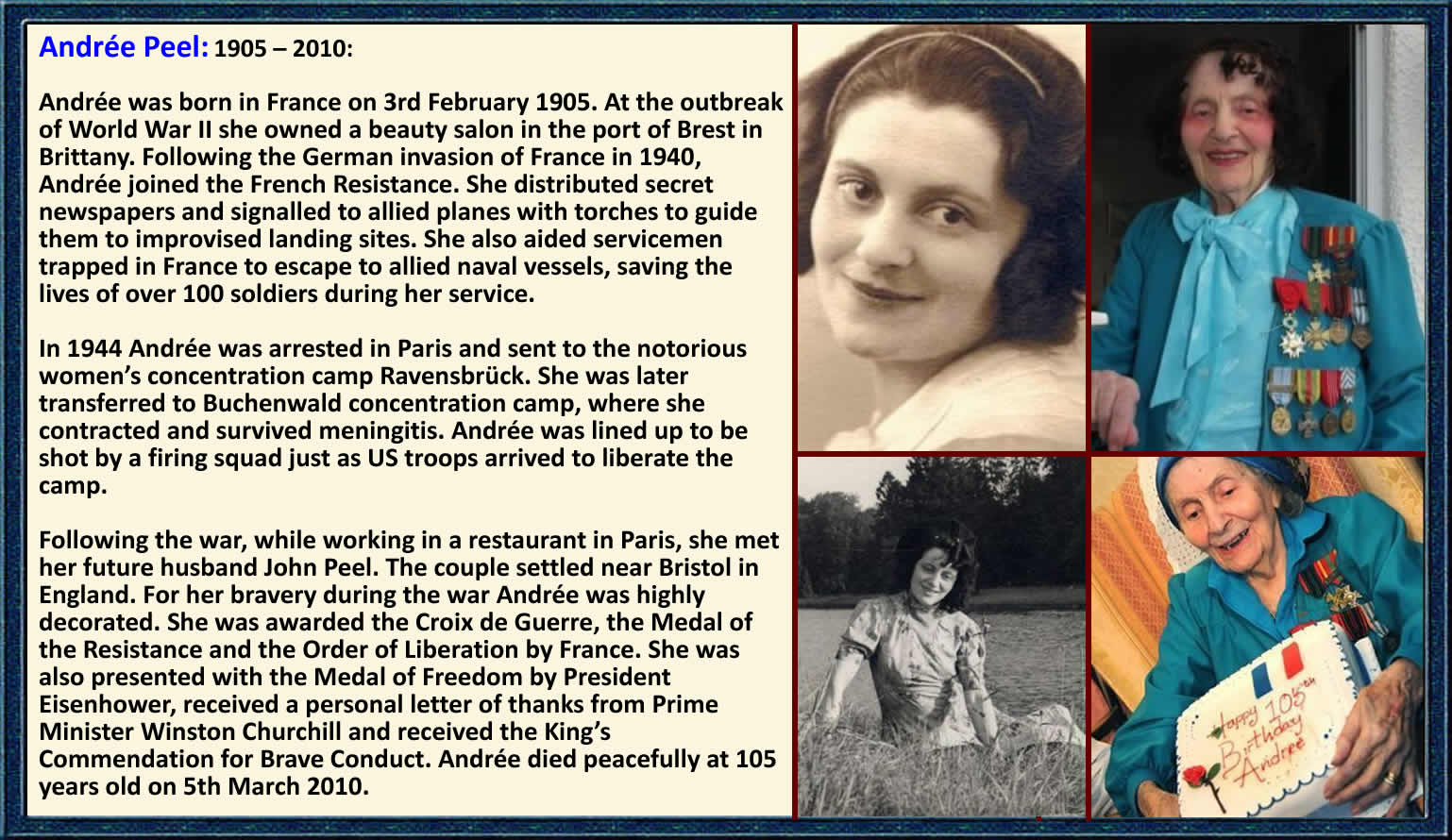
Andrée Peel: Buchenwald concentration camp, late April 1945. The soldiers were almost at the wall when the telephone rang. She and a group of prisoners had been lined up. They had heard that other prisoners had been shot that week, others killed with flamethrowers. The firing squad was approaching. The Nazis were trying to eradicate everything before the Americans arrived. Then a telephone in the commandant's office: a message from the US Army. They had seen the firing squad enter the camp. If the guards wanted to live, they would spare the prisoners.The soldiers fled.
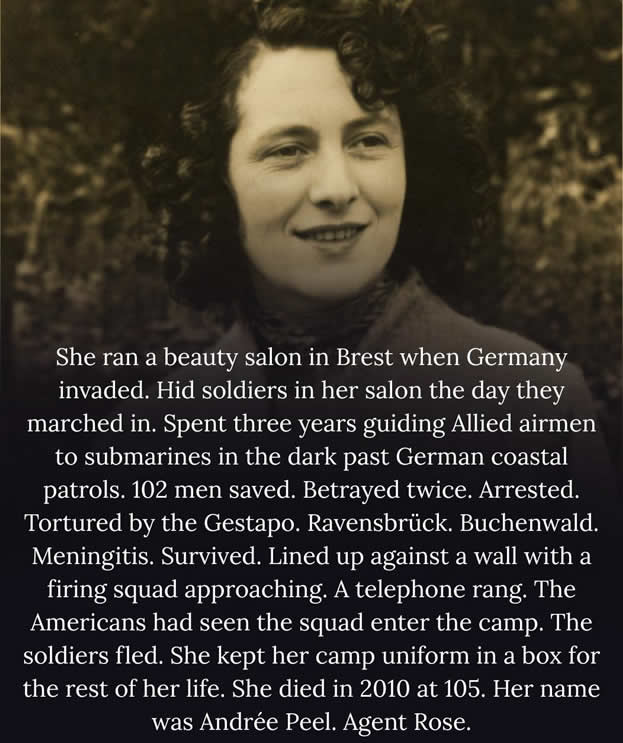
Andrée Peel — hairdresser from Brest, Agent Rose of the French Resistance, the woman who had guided 102 Allied airmen to safety in the dark — walked away from the wall and into the rest of her life. She was born in 1905 in France, raised in a religious and deeply patriotic family, her father a civil engineer who built bridges. When war broke out in 1939 she was running a beauty salon in the port city of Brest, Brittany. The day German troops marched into Brest in 1940 she hid a group of fleeing French soldiers in her salon and begged her neighbors for civilian clothes so they wouldn't be captured. When de Gaulle broadcast his famous June 18 message — "France has lost a battle but she has not lost the war." — she typed out copies with friends and slipped them through letterboxes across the city. She started distributing clandestine resistance newspapers. Then she was appointed head of a resistance section. Then she became Agent Rose |
 |
| Brest was one of the most important naval bases in occupied France. She established contacts in the dockyard and sent reports on shipping movements, naval installations, and the results of Allied aerial bombardments back through the resistance network. She knew the bombs were falling on her own city — sometimes missing the harbor and hitting the town — and she kept reporting anyway. She recalled a man whose house had been destroyed who leaped with joy when he found his BBC radio still intact in the rubble. She remembered teenagers singing "What joy, Tommy, now that we are united at last." to a popular tune while British bombs fell around them. Her most dangerous work was at night on the coast. She and her team crept through the dark past German coastal shelters to remote beaches and clifftops, carrying torches. They signaled to Allied planes overhead, guiding them to improvised landing strips. They smuggled Allied airmen — parachuted from shot-down planes, hiding in barns and attics across occupied France — to those same beaches and put them on submarines and gunboats. Any family found harboring a downed airman could be shot. She did this for three years. One hundred and two Allied pilots and airmen made it home because of her.
In 1943 a comrade betrayed her — a man who had been forced to watch his own family tortured by the Gestapo and could not hold any longer. She fled Brest, went to Paris, assumed a new identity. One week after D-Day, June 1944, another comrade broke under torture and gave her name. The Gestapo arrested her. She was taken to their headquarters, stripped, interrogated, and tortured: simulated drowning, beatings around the throat so severe that her gullet was displaced and her tonsils were crushed. She would suffer pain from those injuries for the rest of her life. They transferred her to Ravensbrück. On arrival the prisoners were marched into what she later realized was a gas chamber. The door opened. They were released instead — she never knew why. At a later roll call her number was read out for selection. A fellow prisoner grabbed the piece of paper with her number on it and hid it. She was not taken. She contracted meningitis at Ravensbrück and survived. She was transferred to Buchenwald. And then the firing squad. And then the telephone. She was liberated in April 1945.
She went home to Brest. Her father was dead — he had walked too close to a German soldier who was fishing using hand grenades. A brother had been killed in Germany fighting with the Free French. The city had been devastated by the war that had freed it. She went to Paris and managed a restaurant near the Luxembourg Gardens — La Caravelle, first-class cuisine at acceptable prices. Her reputation as a former Resistance worker attracted politicians, diplomats, and Allied veterans looking to find the woman who had saved them or saved people they knew. One day a young English student named John Peel walked in with the most comical French accent she had ever heard. She offered him lessons. They married. They settled in Long Ashton near Bristol, England. She kept her striped blue-and-grey camp uniform folded in a box for the rest of her life. She wrote her autobiography — "Miracles Do Happen" — in 1999. She received the Croix de Guerre twice, the Medal of the Resistance, the Liberation Cross, the American Medal of Freedom from President Eisenhower, and the King's Commendation for Brave Conduct.
When she turned 100 she said: "I still feel like a woman of 50. I think that time has forgotten me." She said the secret to a happy life was a good companion and eating the main meal of the day at lunchtime. She died on March 5, 2010. She was 105 years old — possibly the longest-lived survivor of the Nazi concentration camps.
At some point, long after the war, she was asked what she would say to the 102 men she had guided to safety in the dark on the coast of Brittany. She said: "At that time we were all putting our lives in danger but we did it because we were fighting for freedom. It was a terrible time but looking back I am so proud of what I did and I'm glad to have helped defend the freedom of our future generations." |