 |
 |
|
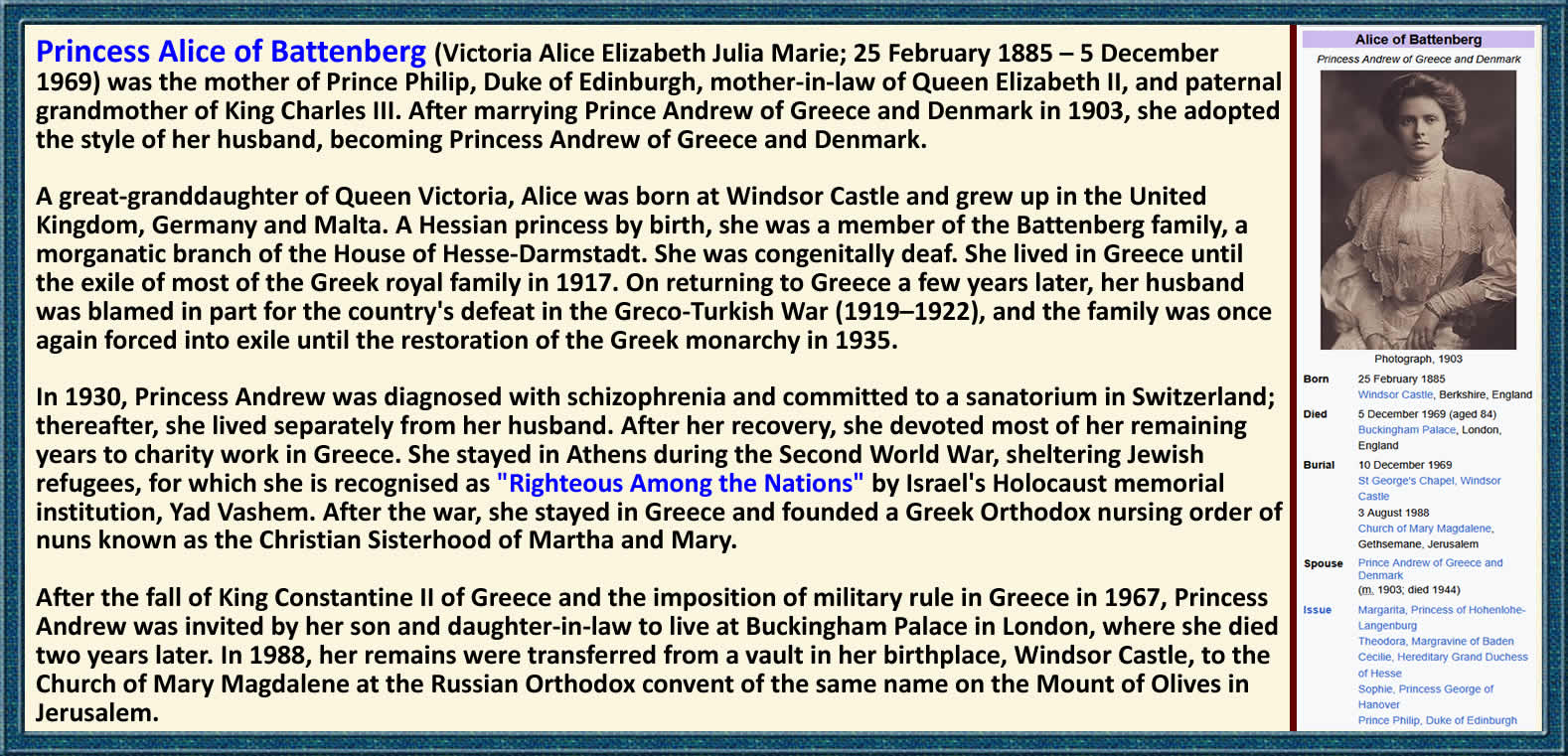
The Gestapo officer looked across the table at the small woman in the nun's habit and asked his question. She stared back at him blankly. He repeated it. She tilted her head slightly, the way a person does when they are trying very hard to understand. Nothing. He tried again, louder this time, leaning forward. She watched his lips move and gave him a look of patient, helpless confusion. The officer eventually stood up, gathered his papers, and left. What he didn't know — what almost nobody in Nazi-occupied Athens knew — was that Princess Alice of Battenberg could lip-read in four languages. She was one of the finest lip-readers in Europe. She had been reading lips since childhood. She was also hiding a Jewish family in her palace. She had been born in Windsor Castle in 1885, a great-granddaughter of Queen Victoria, into the highest tier of European royalty. She was also born profoundly deaf — completely unable to hear from birth. In an era when deafness was considered a defect to be hidden, her parents refused to hide it. They taught her to lip-read in English, German, French, and Greek. They treated her not as a damaged child but as a child who experienced the world differently. She grew up remarkable. She was brave in the physical sense — during the Balkan Wars of 1912, she left her children and went to the front lines, setting up field hospitals and working through the night. During the First World War she did it again. King George V gave her the Royal Red Cross for her service. She had married Prince Andrew of Greece in 1903, and together they had five children — four daughters and one son, the youngest, born in 1921 on the island of Corfu on a kitchen table. They named him Philip. Then her life fell apart. Greece erupted in political crisis. Her husband was arrested, put on trial by a revolutionary court, and sentenced to death. A British warship extracted the family in the night. They fled to Paris with almost nothing. Philip was eighteen months old and was carried aboard in a crib made from a fruit box: exile, poverty, a husband who drifted away. Then, in 1930, at the age of forty-five, Princess Alice suffered a breakdown and was diagnosed with paranoid schizophrenia. Her family, acting on the advice of doctors — including Sigmund Freud, who recommended X-raying her ovaries — had her committed to a sanatorium in Switzerland against her will. She spent years trying to escape. She finally did. By the late 1930s she had converted to Greek Orthodox Christianity and returned to Athens alone, wearing the gray habit of a nun, living simply in a small apartment and doing charity work among the city's poor. Her children were scattered across Europe. Philip was at school in Britain, then serving in the Royal Navy. Her daughters had married into the German nobility — her sons-in-law were fighting for the Nazis. She was, by any measure, a woman who had lost almost everything. When the Germans occupied Athens in 1941, Princess Alice did not leave. She knew the Cohen family — Haimaki Cohen had been a member of the Greek parliament, a friend of the royal family for decades. By 1943, Haimaki was dead. His widow Rachel and two of their children — a daughter named Tilde and a son named Michael — had nowhere to go. The Nazis had begun rounding up Greek Jews for deportation. Sixty thousand Greek Jews would die in the Holocaust. The Cohens were running out of time. Princess Alice opened her door. She moved them into her residence quietly, without telling anyone. For over a year, Rachel, Tilde, and Michael lived hidden in the palace while the occupation continued around them. Alice visited them regularly, sitting with Rachel over tea, talking about faith and family and the small things that make days bearable when the world outside has become unlivable. She sold her remaining jewellery to buy food. Not just for the Cohens — for the neighbourhood's hungry. She went on distributing food and medicine through the Swedish and Swiss Red Cross, moving through the occupied city in her nun's habit, hiding in plain sight. The Germans became suspicious more than once. Neighbors noticed things. Officers came to ask questions. One day the Gestapo came to the palace directly. They wanted to know who was living there. They asked questions. Princess Alice — born deaf, who had spent her entire life reading the movements of other people's mouths — sat across from the officer and performed the role of a confused, hard-of-hearing old woman with complete conviction. She understood every word he said. She answered nothing. He left. The Cohens stayed until the liberation of Athens in October 1944. After the war, Princess Alice attended her son Philip's wedding to Princess Elizabeth in 1947. She appeared in the photographs — thin, gray-habited, slightly apart from the magnificence around her. She founded a nursing order of Greek Orthodox nuns in a poor suburb of Athens. She kept working, kept giving things away, kept living simply in a city that the rest of her family had long since left behind. In 1967, a military coup forced her to leave Greece for the last time. Philip sent a plane. She came to Buckingham Palace reluctantly, in failing health, and died there two years later on December 5, 1969. She was eighty-four years old. She left no possessions. She had given everything away. Her wish was to be buried in Jerusalem, on the Mount of Olives, near her aunt who had also founded a convent and also died for her faith. It took nineteen years for the wish to be granted. In 1988 her remains were transferred to the Church of Mary Magdalene in Gethsemane. In 1994, twenty-five years after her death, her son — Prince Philip, Duke of Edinburgh, husband of the Queen of England — traveled to Yad Vashem in Jerusalem. He stood in the Hall of Remembrance and accepted Israel's honour on his mother's behalf. Righteous Among the Nations: one of the highest distinctions the Jewish people give to those who saved lives at the risk of their own. He said afterward: "It never occurred to her that her action was in any way special. She was a person with a deep religious faith, and she would have considered it to be a perfectly natural human reaction to fellow beings in distress." The Gestapo officer who came to question her never knew he was sitting across |