In 1943, inside a Gestapo interrogation room in Paris, a woman sat across from officers who
believed pain would eventually make her talk. They were wrong. Her name was Odette Sansom.
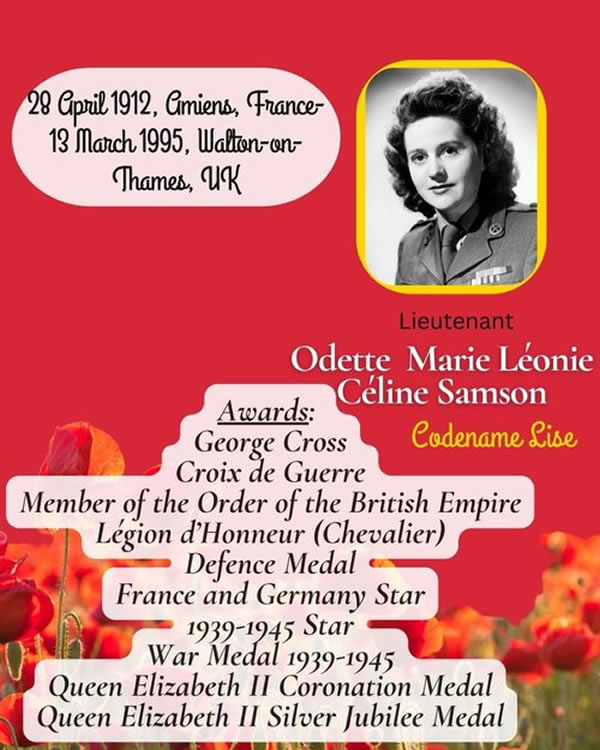
She had been born in Amiens, France in 1912, moved to England after her marriage, and was raising three daughters when the war broke out. By any ordinary measure, she was the last person who should have been in that room: she had no military training, no combat experience. She was a civilian mother who had answered a British government appeal for French speakers willing to work behind enemy lines. She said yes. Most people didn't.
In 1942, she was sent into occupied France under the code name Lise, working as a courier for the Special Operations Executive — an organization built to support resistance networks and disrupt German operations across Europe. The work meant false identity papers, constant travel by train and bicycle through occupied territory, and the knowledge that a single betrayal could end everything. She carried messages. She coordinated logistics. She helped keep a resistance network functioning in southern France. In April 1943, a local informant gave them up.
Odette and the officer she worked alongside, Peter Churchill, were arrested and transferred to Paris. What followed in the interrogation room was systematic and deliberate. She was beaten. Her toenails were removed. She was burned with heated implements. The purpose was not punishment — it was extraction. The Germans wanted names, addresses, and radio codes that would unravel the entire network she had served. She gave them nothing. Instead, she did something unexpected. She told her captors that Peter Churchill was related to the British Prime Minister — a fiction she constructed on the spot, designed to make them both appear more valuable alive than dead. It worked, at least long enough to matter. The immediate executions were delayed.
She was eventually deported to Ravensbrück concentration camp in Germany, where prisoners endured forced labor, malnutrition, and the constant presence of death. She remained there until the final weeks of the war. In April 1945, as Allied forces closed in, she was transferred under guard to Bavaria, where German officers ultimately surrendered her directly to American troops. She had survived.
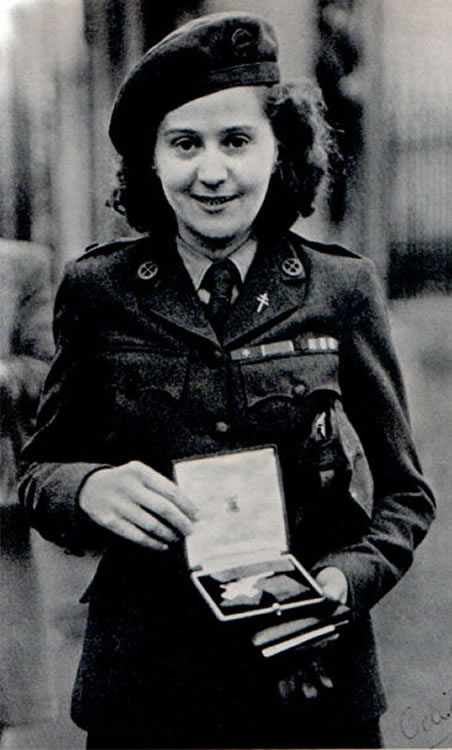
After the war, the recognition came formally and significantly. She became the first woman to receive the George Cross, Britain's highest civilian decoration for acts of the greatest heroism. France awarded her the Légion d'honneur and the Croix de Guerre. The honors were real, but they were not what she talked about when she spoke publicly about her experience. She talked about obligation.
She said she had stayed silent not because she was fearless, but because she understood the arithmetic of what speaking would have cost. Every name disclosed was another arrest. Every address given was another family destroyed. She had made a calculation in that room — that her pain was finite, and that the damage her words could cause was not.
Odette Sansom lived until 1995. She carried the physical consequences of what had been done to her for the rest of her life. She had not been a soldier. She had not been trained for what she endured. She had been a mother who made a decision in 1942 and then kept making it, day after day, in a cell, in an interrogation room, in a concentration camp, until the world finally caught up with the side she had chosen. History remembers the battles fought in open fields. It is slower to remember the ones fought in rooms with no witnesses, where the only weapon available was refusal. Odette Sansom refused. And people lived because she did. |