 |
 |
|
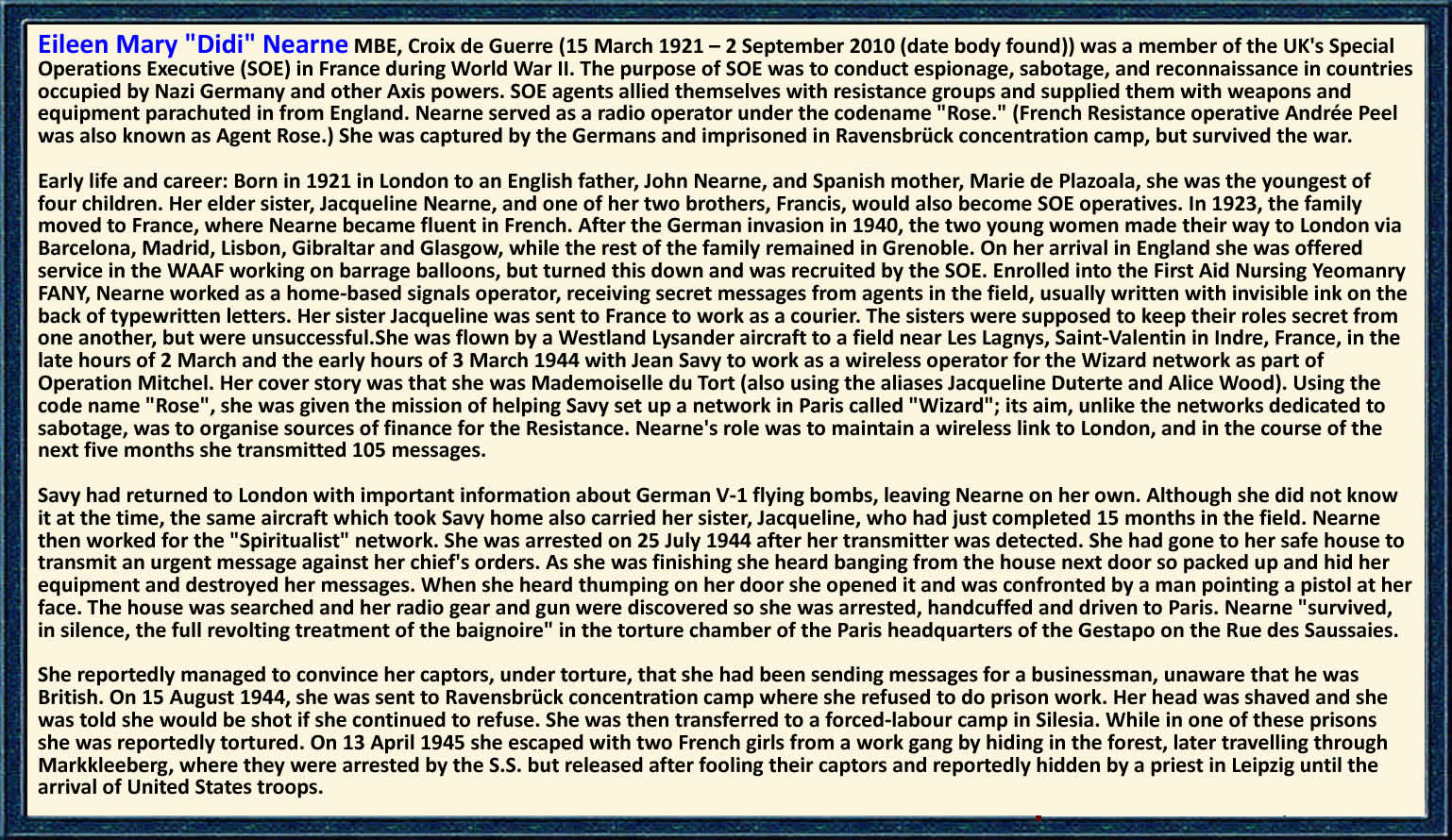
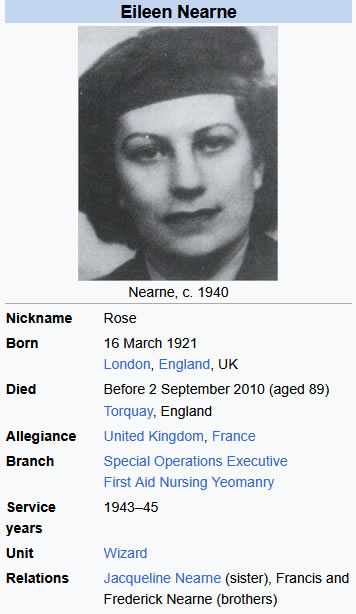
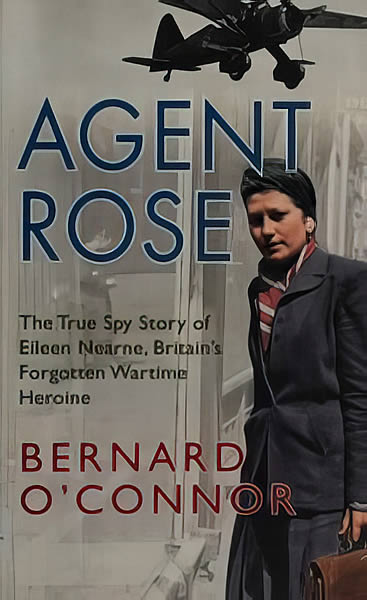
Eileen Mary "Didi" Nearne MBE, Croix de Guerre (15 March 1921[1][2] – 2 September 2010 (date body found)) was a member of the UK's Special Operations Executive (SOE) in France during World War II. The purpose of SOE was to conduct espionage, sabotage, and reconnaissance in countries occupied by Nazi Germany and other Axis powers. SOE agents allied themselves with resistance groups and supplied them with weapons and equipment parachuted in from England. Nearne served as a radio operator under the codename "Rose." (French Resistance operative Andrée Peel was also known as Agent Rose.) She was captured by the Germans and imprisoned in Ravensbrück concentration camp, but survived the war. Early life and career: Born in 1921 in London to an English father, John Nearne, and Spanish mother, Marie de Plazoala, she was the youngest of four children. Her elder sister, Jacqueline Nearne, and one of her two brothers, Francis, would also become SOE operatives. In 1923, the family moved to France, where Nearne became fluent in French After the German invasion in 1940, the two young women made their way to London via Barcelona, Madrid, Lisbon, Gibraltar and Glasgow, while the rest of the family remained in Grenoble. On her arrival in England she was offered service in the WAAF working on barrage balloons, but turned this down and was recruited by the SOE. Enrolled into the First Aid Nursing Yeomanry FANY, Nearne worked as a home-based signals operator, receiving secret messages from agents in the field, usually written with invisible ink on the back of typewritten letters. Her sister Jacqueline was sent to France to work as a courier. The sisters were supposed to keep their roles secret from one another, but were unsuccessful. The year was 1944, and the stakes for the Allied forces could not have been higher as the preparations for D-Day reached fever pitch. In this atmosphere of high-tension espionage, twenty-three-year-old Eileen Nearne stepped forward to volunteer for Britain’s Special Operations Executive (SOE). Her assignment was arguably the most suicidal role in the field: a wireless operator in Nazi-occupied France. At the time, the average life expectancy for a radio operator in the field was a harrowing six weeks. The German forces utilized advanced direction-finding equipment - mobile units that cruised through French streets like sharks, hunting for the specific electronic pulse of a clandestine transmission. Once a signal was intercepted, the Gestapo could triangulate a location within minutes, and the penalty for operating a wireless was immediate execution. Eileen was an unlikely candidate for such a grim profession. Having fled France with her family during the initial Nazi invasion, she arrived in Britain as a quiet, unassuming young woman. When she applied for the SOE, recruiters were initially skeptical; she appeared fragile, reserved, and almost too ordinary for the psychological rigors of undercover warfare. However, her superiors soon realized that her lack of a "soldierly" presence was her greatest weapon. She could blend into a crowd, disappear into a village, and look a German officer in the eye without triggering the slightest suspicion. In March 1944, she parachuted into the darkness of occupied France under the alias "Rose," carrying little more than her radio, forged identity papers, and an iron-willed sense of duty. For the next four months, Eileen became the invisible heartbeat of the French Resistance. She operated in a state of constant, low-level terror, setting up her heavy radio equipment in damp attics, forgotten basements, and abandoned farmhouses. Her task was to transmit coordinates for weapon drops, intelligence on German troop movements, and confirmations of sabotage missions that would eventually cripple the Nazi response to the Allied invasion. Every time she keyed her transmitter, she was essentially screaming her location to the enemy. She had to remain perfectly calm, encoding and decoding complex ciphers with meticulous accuracy while straining to hear the sound of German trucks pulling up outside her window. In July 1944, the inevitable happened: the Gestapo closed in. Eileen was arrested during a sweep of her network, but the Nazis did not initially realize they had captured the prized wireless operator. They subjected the five-foot-tall, 100-pound woman to a series of interrogations that would have broken the strongest men. They used the "baignoire" - a horrific waterboarding technique - along with beatings and psychological torment. Despite the agony, Eileen never surrendered her secrets. She leaned into her "ordinary" persona, insisting she was a simple, naive French saleswoman who had been tricked into helping people she didn't know. Her performance was so convincing, and her silence so absolute, that the Gestapo eventually concluded she was a mere bystander. This act of supreme deception saved the lives of dozens of agents and allowed the Resistance network to continue its work, though Eileen herself was sent to the living hell of the Ravensbrück concentration camp. Eileen’s survival in the camps was a testament to a quiet, stubborn resilience. She endured starvation, forced labor, and the constant threat of the gas chambers, eventually escaping during a forced march in the spring of 1945 as the Third Reich crumbled. When she finally returned to Britain, she was a ghost of her former self, a twenty-four-year-old who had witnessed the worst of humanity. Although she was awarded the MBE and the Croix de Guerre, her work was immediately swallowed by the Official Secrets Act. She was forbidden from discussing her missions, and so she simply stopped talking. For the next sixty-five years, Eileen lived a life of extreme privacy in the seaside town of Torquay. She never married, never had children, and never sought the spotlight. Her neighbors knew her only as a polite, solitary woman who walked her dog and lived modestly on a small pension. When she died alone in 2010 at the age of eighty-nine, her body remained undiscovered for several days. Local officials, seeing no family and no assets, prepared for a pauper’s funeral - a basic, anonymous send-off for a woman they believed had left no mark on the world. She was tortured by the Gestapo, survived a concentration camp, and helped win WWII - then died alone and forgotten in a tiny apartment, with no one knowing she'd been a spy. The truth only emerged when council workers began clearing her flat and discovered a cache of old papers, medals, and letters from the French government. The revelation that the "lonely old lady from the apartment" was actually "Agent Rose" sent shockwaves through the British media. The planned anonymous cremation was canceled, replaced by a full military funeral attended by hundreds of grateful citizens and veterans. A bugler played the "Last Post" over a coffin draped in the Union Jack, finally giving Eileen Nearne the honor she had earned sixty years prior. |
 |
 |
 |
|
 |