 |
 |
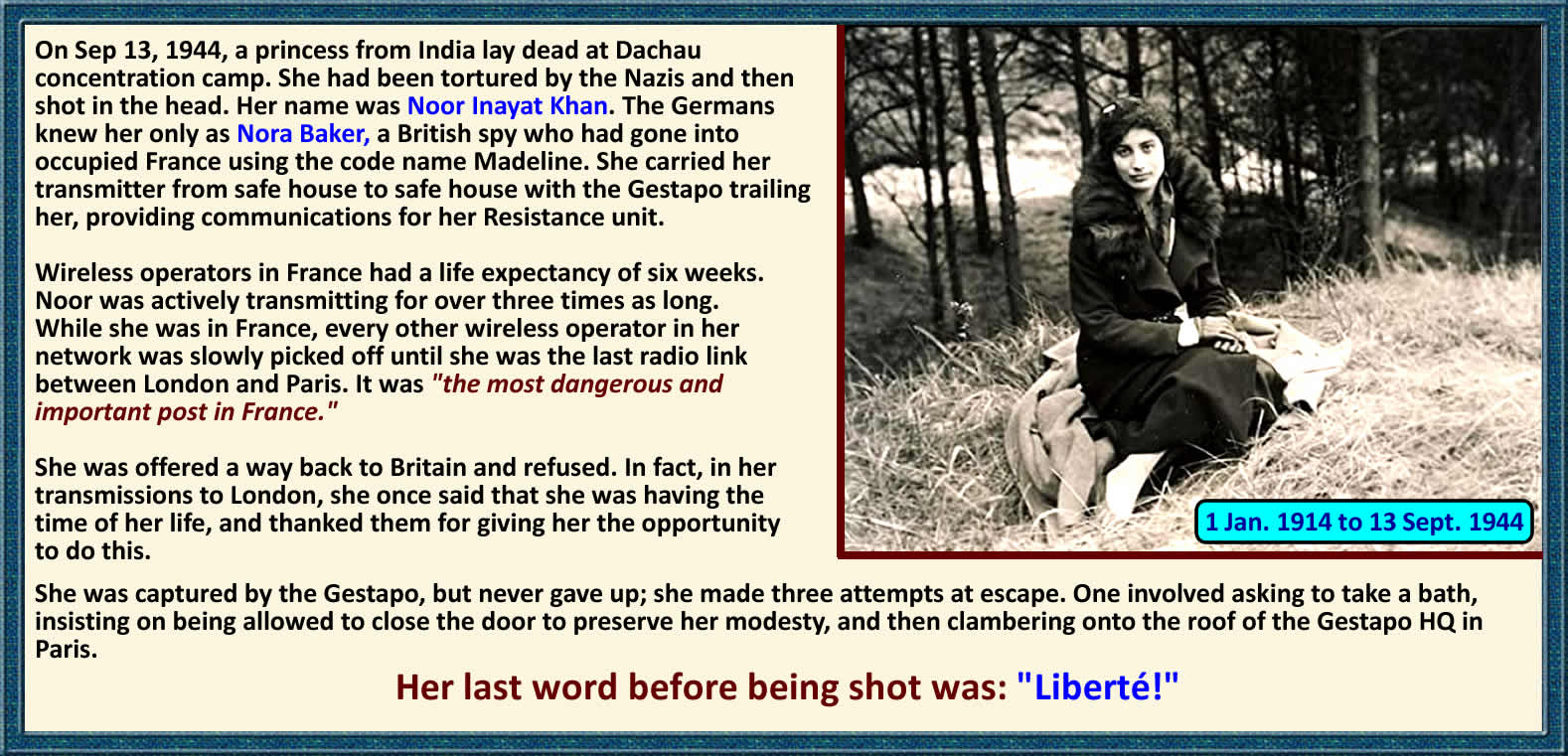
| They called her a dreamer, a princess, a spy - but when the Nazis executed her at age 30, history almost forgot the Muslim woman who became one of Britain's most courageous WWII heroes.
September 13, 1944. Dawn breaks over Dachau concentration camp. A young woman is led across the yard. The interrogations hadn't broken her. The beatings hadn't broken her. Months of solitary confinement in chains - still, she had given them nothing. ow, as an SS officer raises his pistol, witnesses would later report hearing her speak. ne word. Defiant to the end. She was born between cultures, between continents. Her father was an Indian Sufi mystic descended from royalty. Her mother was American. Noor grew up speaking multiple languages, studying music at the Paris Conservatory, playing Debussy on the piano. When Nazi Germany crushed France - the country she called home - Noor faced an impossible choice. Everything she believed argued for nonviolence. Every principle she held sacred said war was wrong. ut freedom itself was under attack so she chose to fight: not by abandoning her principles, but by redirecting them. If fascism meant the death of everything good in the world, then defending freedom was the most moral act possible. In 1943, she joined Britain's Special Operations Executive - the covert force Winston Churchill created to "set Europe ablaze" behind enemy lines. She trained as a wireless radio operator, knowing full well what that meant. adio operators in occupied territory were hunted relentlessly. Nazi detection vans triangulated signals within hours. Capture meant torture. Torture meant death. he expected survival time for a radio operator in Nazi-occupied France was six weeks; Noor lasted four months. She parachuted into Paris under the code names Nora Baker and Madeleine, carrying a heavy wireless transmitter that could get her killed just for possessing it. She moved from safe house to safe house, sending coded Morse messages to London that kept French Resistance cells coordinated and alive. very transmission risked exposure. Every knock at the door could be the Gestapo. Every night could be her last. And then the network began to collapse. ne by one, agents were arrested. Safe houses were raided. The Paris Resistance was being systematically dismantled by Nazi intelligence. Noor's superiors ordered her to evacuate immediately - the network was compromised, staying meant certain capture. She refused. For weeks, she became the only functioning radio link between occupied France and London. British intelligence later called it "the most dangerous post in the country." Her commanders begged her to come home. She kept refusing. In one transmission, she wrote something extraordinary: despite the constant terror, she was having "the time of her life." She felt honored to serve. Grateful to resist. Alive in a way that fear could never erase. Then came betrayal. In October 1943, someone revealed her location. The Gestapo surrounded her safe house and captured her along with her codebooks - clear proof she was a British agent. Most captured operatives broke within days under interrogation. The Gestapo were experts at extracting information through pain and terror. Noor never cooperated. Never named a single name, never surrendered one piece of useful information. Instead, she tried to escape. Three times she attempted it. Once, she convinced guards to let her bathe privately, then tried to climb onto the roof of Gestapo headquarters in Paris to escape across the rooftops. After that, they kept her in chains. Still, she gave them nothing. The Gestapo had never encountered anyone quite like her - a gentle woman who wrote children's stories, who meditated and prayed, who refused to hate even her captors. And yet, she was made of something unbreakable. Eventually, they sent her to Germany, to Pforzheim prison, where she spent ten months in solitary confinement, shackled hand and foot.Still, she resisted. By September 1944, the war was turning against Germany. The Nazis decided Noor was too dangerous to keep alive. She was transferred to Dachau with three other female SOE agents: Yolande Beekman, Eliane Plewman, and Madeleine Damerment. At dawn on September 13, all four women were led out to the execution yard. According to testimony from other prisoners, just before the shot was fired, Noor spoke her final word. "Liberté."She was thirty years old. After the war ended, Britain awarded her the George Cross - the highest civilian honor for bravery. France gave her the Croix de Guerre but for decades, her story remained mostly unknown. A Muslim woman of Indian heritage who became one of Britain's bravest WWII agents didn't fit the narratives people preferred about heroes. She was quietly honored, then quietly forgotten. Only recently has history begun speaking her name properly. In 2012, a bronze memorial statue was unveiled in London's Gordon Square - the first memorial to a Muslim woman in Britain, the first memorial to an Asian woman in the UK. Her children's stories have been republished. Her courage is finally being remembered. |