 |
 |
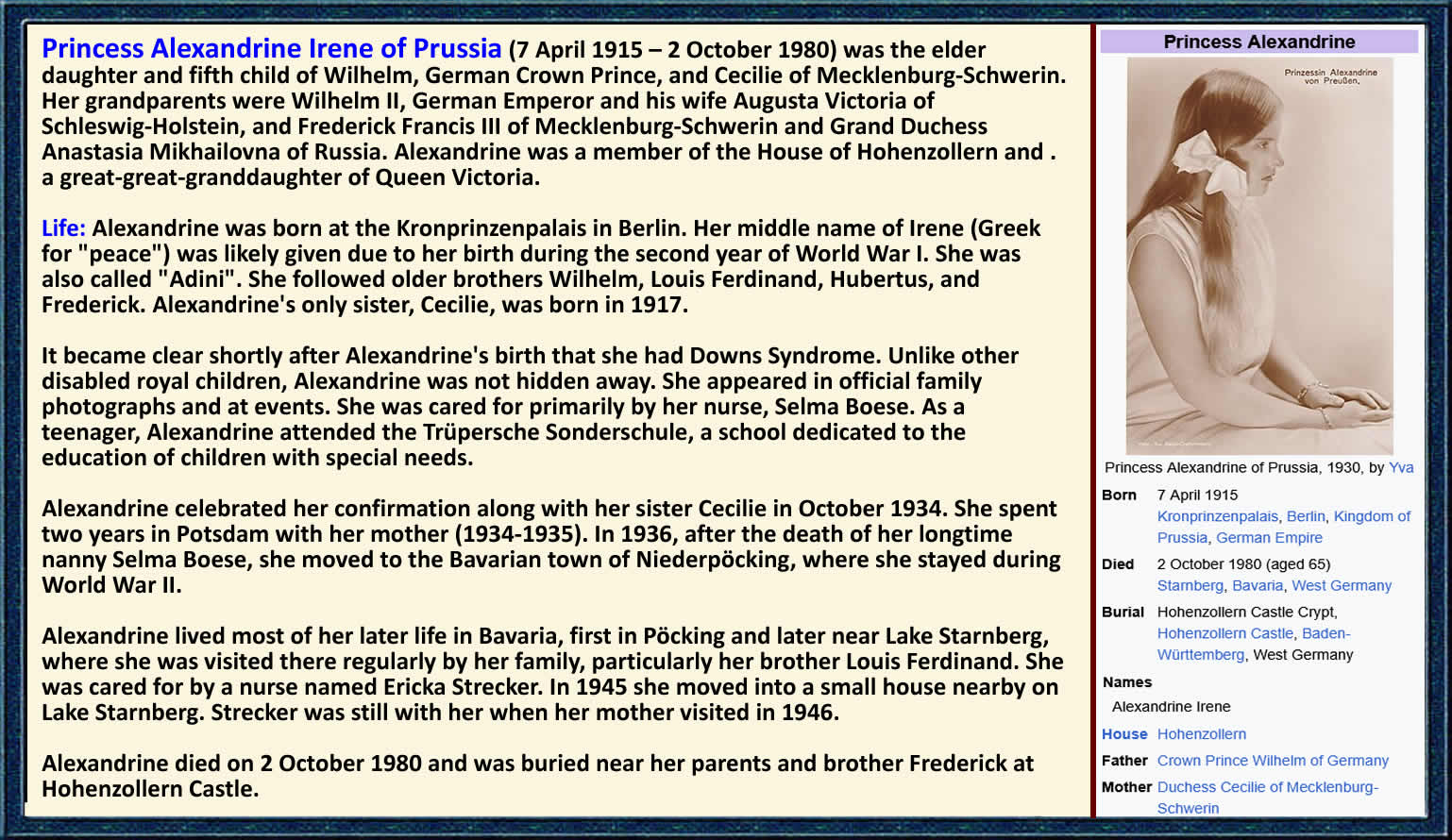
| When she was born in 1915, the expected response was silence. She was a princess with Downs syndrome — the granddaughter of Kaiser Wilhelm II, born into one of the most powerful dynasties in Europe. And in 1915, across aristocratic and ordinary families alike, the expectation when this happened was understood by everyone involved without needing to be stated: you removed such a child from sight; you sent her to an institution; you protected the family's reputation by making her invisible. Society had a procedure for what her family was supposed to do:
hide her.
Her family refused.
Her name was Alexandrine Irene. Her second name meant peace — chosen during the devastation of the First World War, in the particular hope of parents who understood what the world outside their walls was doing to itself. Her family called her Adini. They kept her at home, with her brothers, with her nanny, within the daily life of the household. They included her in official family portraits — photographs that were printed on postcards and distributed across Germany, because that was what royal families did. A princess with Down syndrome, standing visibly among her siblings, held by her mother. Her mother, Crown Princess Cecilie, described her as "the sunshine of our house." In an era when silence and institutional removal were the socially enforced responses to disability in prominent families, this was not a small thing. It was a deliberate, visible, sustained act of defiance against everything their world expected. Then the world they belonged to collapsed. In 1918, Germany lost the First World War. Kaiser Wilhelm II abdicated. The German Empire dissolved overnight. Crown Prince Wilhelm went into exile. The family lost their status, most of their wealth, and the entire future that had been promised to them. But through the upheaval, through the exile, through the financial strain of rebuilding a life without an empire — they did not lose their devotion to Alexandrine. In her teenage years she attended one of Germany's pioneering special education institutions in Jena. She was confirmed in the Lutheran church in 1934, standing beside her younger sister Cecilie, in the church, in front of the congregation, present and included in the ritual of family life the same way she had always been. She was not erased from the family story when the empire fell. She was part of it. She had always been part of it. Then 1939 arrived. The Nazi regime launched Aktion T4 — a systematic program to identify and murder disabled Germans. It was bureaucratically organized and clinically executed. Doctors received lists of names; buses arrived at institutions carrying patients away; gas chambers built to look like shower rooms were constructed and put into operation with the efficiency the regime applied to all of its atrocities. Between 1940 and 1945, more than 200,000 disabled people were killed under this program. Most of them were reached through institutions — places where families had placed their children, often with genuine care and genuine belief that professional supervision was the right choice. When the Nazi apparatus came for them, there was no one in those places with both the will and the standing to stop it. Alexandrine was not in an institution. She had never been sent to one. She was living privately in Bavaria — in the small town of Niederpöcking, near Lake Starnberg, cared for by a private nurse, visited regularly by her mother and her siblings. She had been there since 1936. She was surrounded by family who knew where she was and who she was. When the genocide swept through Germany's institutional system and took everyone the apparatus could reach — it could not reach her. Because the people who loved her had never let go of her. The choice that had seemed, in 1915, like a private family decision about visibility and dignity — the choice to keep her home, to include her in photographs, to call her their sunshine — turned out to be the choice that saved her life. She survived the Second World War. She outlived her father, Crown Prince Wilhelm, who died in 1951. She outlived her mother, who died in 1954. Her brother Wilhelm had been killed fighting in France in 1940 — the empire gone, the family diminishing, the world she had been born into falling away piece by piece - but Alexandrine endured, visited faithfully by her remaining siblings, living quietly in Bavaria, surrounded by the particular peace of someone who has been loved without condition for a very long time. On October 2, 1980, Princess Alexandrine Irene died peacefully in Bavaria. She was 65 years old. Consider what that means in context. When she was born in 1915, life expectancy for a person with Downs syndrome was less than ten years. Most children with her diagnosis did not survive childhood, because they were institutionalized in conditions that provided neither care nor survival. She lived six and a half decades. She outlived the empire she was born into by more than sixty years. She survived a genocide specifically designed to kill people like her. Today, with modern medicine and genuine inclusion, average life expectancy for someone with Downs syndrome is approximately 60 years — meaning Alexandrine, even by the standards of our own era, lived a remarkable length of life. She was buried at Hohenzollern Castle, in the family crypt, beside her parents and her brother Frederick. The photographs still exist: a baby in christening clothes; a child standing among her brothers; a young woman at her confirmation, beside her sister. In every image, she is there — not hidden at the edges, not cropped out, not softened or erased, but present, fully, visibly, unmistakably part of the family that chose her. Her family was not without its moral complications. Her father had political entanglements with the regime that would have killed his daughter, entanglements that he later distanced himself from but never fully escaped in historical judgment. The Hohenzollerns built their empire through conquest and power. None of that is simple or clean. But within the walls of their private life, across 65 years, they made a choice that stood in direct defiance of everything their era demanded. When the world said hide her, they included her in the official photographs. When society called her a burden, her mother called her the sunshine of the house. When the empire fell and there was nothing left to protect, they kept protecting her. When a genocide came for everyone in the institutions, she was not in an institution — because she had always been home. The choice made in 1915 — to simply love her openly, to make her visible, to refuse the silence that everyone around them accepted as reasonable — did not just give her a good life. It gave her a life at all. Alexandrine did not change laws or lead movements. She lived quietly, was loved steadily, was visited faithfully, and survived. That is not a small thing. In the particular century she was born into, in the particular country, in the particular decade when the worst of it came — surviving while being visibly, publicly, unmistakably herself is one of the most remarkable things a person with Downs syndrome could do. She did it for 65 years - because the people who loved her refused, in 1915 and every year after, to look away. |