 |
 |
 |
 |
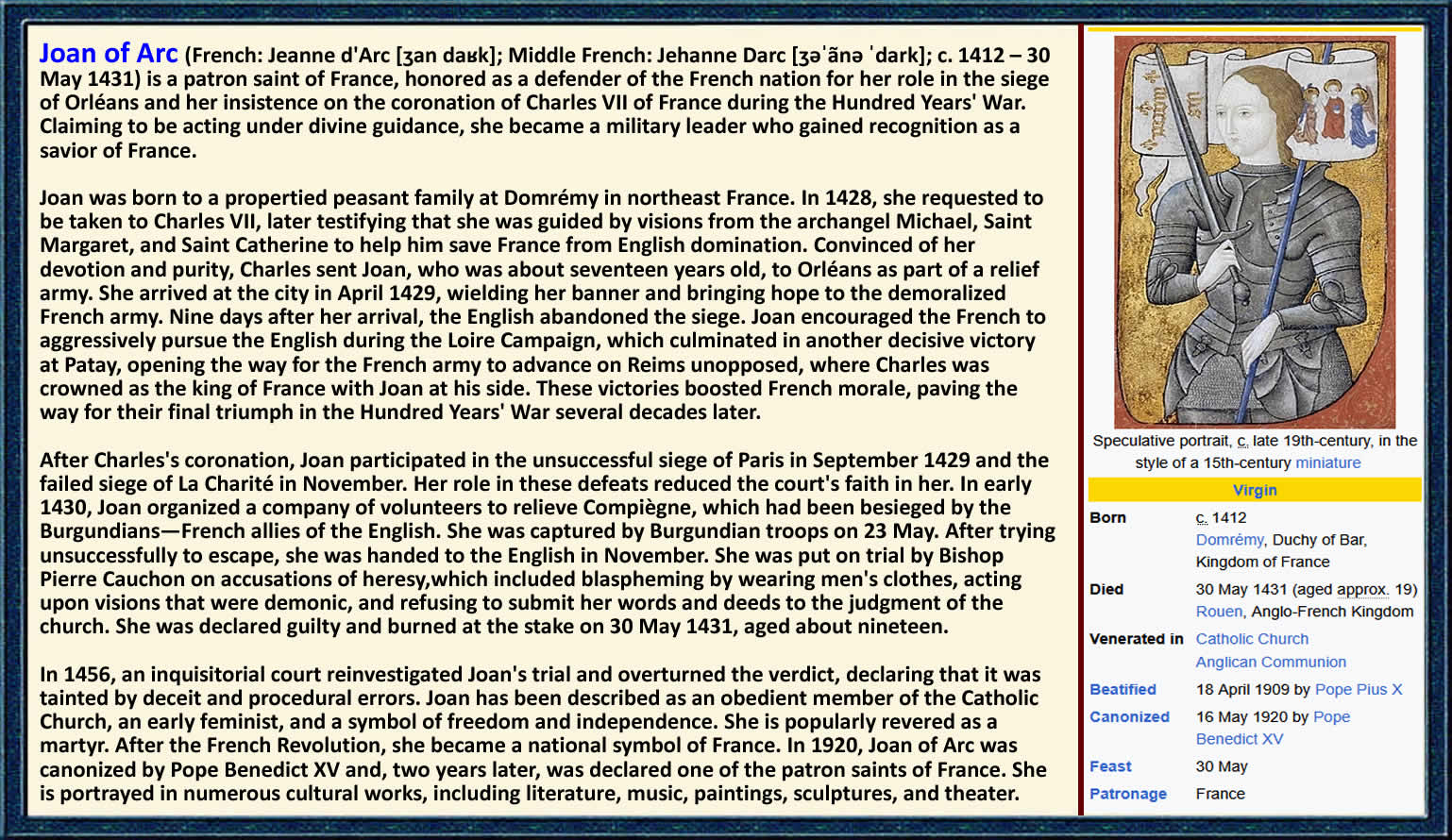
When Joan of Arc (1412-1431) or in French Jeanne D'Arc, was a child the territory where she lived— Domremy-la -Pucell — like much of France, was under the control of the English. The future king of France was somewhat in doubt of his claim to the throne, as was his mother who doubted his legitimacy. Even his close advisors were skeptical. This unstable period known as the Hundred Years' War (1337-1453) was marked by constant warfare between France and England. Due to her persistence, Joan, who heard voices from God telling her to save France, was granted a visit with the future king. Upon entering the room it is said she was able to locate him, unmarked, among his courtiers. How remarkable that a young woman of 17 would not only have the conviction that Charles must be crowned king, but had the passion, determination and some might say, delusional courage, to cut her hair, don armor, lead men into battle, and regain the city of Orléans. Through stubborn diplomacy, and as an inspiring leader in battle, she paved the way for Charles to be crowned King Charles VII at Reims (pronounced raanz). While Charles VII successfully claimed the throne, Joan was captured by the British and unjustly burned at the stake as a heretic. The infamous trial of Jeanne d'Arc illustrates the precarious position of women who defied the expectations of their place in society. One of the most courageous women of French history, she was ultimately used and abandoned by the King after her purpose had been served. She was captured and burned at the stake as a heretic (charges also included witchcraft and violating divine law by dressing like a man) by the British and their Burgundian allies. The King, wary of his precarious position did nothing to intervene. One of the most fascinating aspects of Joan of Arc's story is how women can be both revered and feared in equal measure. Crass soldiers are said to have been unable to swear in her presence. She was both commanding and serene. And yet the Church condemned her as an "excommunicated heretic, a liar, a seducer, pernicious...and contemptuous of God." (Parton, James, Daughters of Genius [N.P, 1897],148). How can the same woman be branded as a heretic in 1431 and canonized as a Saint in 1905? Scholars have debated this question for centuries but to the French people, Jeanne d'Arc, is revered as the patron saint of France, and countless celebrations take place every year honoring her bravery and sacrifice for the nation. The story of Joan of Arc is so captivating that even in our modern era the French are drawn to her as a figure of national pride. The 2024 Paris Olympics included the figure of Joan of Arc as an armor-clad warrior on a horse gliding along the Seine river. As historian and travel writer Ina Caro wrote in her infinitely readable book Paris to the Past: Traveling Through French History by Train, an annual festival has been held in Orléans (the town where she delivered an end to the British Siege in 1429) almost every year since the deliverance. The annual Festival in Orléans, features an actor who rides a horse through the city just as Joan did so many centuries ago. Historically it has been a great honor to be chosen to represent Joan and the young teen who was finally selected for the part was required to go through several rounds of vetting to be sure they possessed the ethical and moral rectitude worthy to play the role. There are ten modern stained-glass windows in the Cathedral of Orléans centered on Joan of Arc and her story. As Caro describes, the first one is Joan as a young girl in her hometown of Domrémy being told by the saints to go to Orléans to lift the siege and lead the dauphin (the future Charles VII) to Reims to be coronated. The second window shows Joan in the town of Vaucouleurs where she supposedly said to the captain of the Royal Garrison, Robert de Baudricourt, "Have you not heard it said that it has been prophesied that France shall be lost by a woman and restored by a virgin from the Lorraine marches?". (Caro, p. 133) In the third window Joan is depicted at the Chinon reception where she miraculously recognizes the dauphin who was cleverly dressed below his station to make it impossible for her to single him out. He was hidden among 300 of his courtiers. Joan entered the room and reportedly walked directly to the dauphin and related a story that only he would have known. In the fourth window she is depicted entering Orléans. The fifth window shows her victory at the fortress of Tourelles. The sixth window depicts a scene in the Cathedral of Orléans itself (a sort of meta experience for viewers) at mass at the altar. She is shown in the seventh window at the coronation of Charles VII. In the eighth window she is at Compiègne, where she was captured by the Burgundian forces awaiting the King's ransom. The ransom never came as the King no longer had any use for her. In the penultimate window she is shown bound to the stake at Rouen branded with the words "Heretic, relapsed apostate, idolatress". In the final window she is shown burned at the stake. It is a moving experience to visit this cathedral. Very nearby is the Maison de Jeanne d'Arc (where Joan stayed as a guest of Jacques Boucher who was the financial minister for the Duke of Orléans) located in the middle of Place du Général de Gaulle. It was burned down by the Germans in 1940 but was fastidiously rebuilt and has a complete model of Orléans during the time that Joan was alive. There is a poignant story narrated about how Joan of Arc freed the city and created a turning point in the Hundred Years War, ultimately saving France from British rule. |