|
The Surrender of Japan in 1945
Since the issuance of the Potsdam Declaration on July 26, the Japanese Supreme War Council (the so-called “Big Six”) had been debating whether or not Japan should surrender, and if so, on what terms. Three members of the Council, the so-called “Peace Party” (the Prime Minister, the Foreign Minister, and the Minister of the Navy), favored accepting the terms of the Potsdam Declaration, which they believed would protect the emperor from harm and allow him to remain on the throne. The other three, the so-called “War Party” (the Minister of War, the Chief of Staff of the Army, and the Chief of Staff of the Navy) flatly opposed surrender.
On August 6 the Council received the news that the city of Hiroshima had been destroyed by an atomic bomb. The report did not sway the War Party. Faced with the prospect that Japan might be utterly annihilated by atomic bombs, War Minister General Korechika Anami is said to have remarked, “Would it not be wondrous for this whole nation to be destroyed like a beautiful flower?”
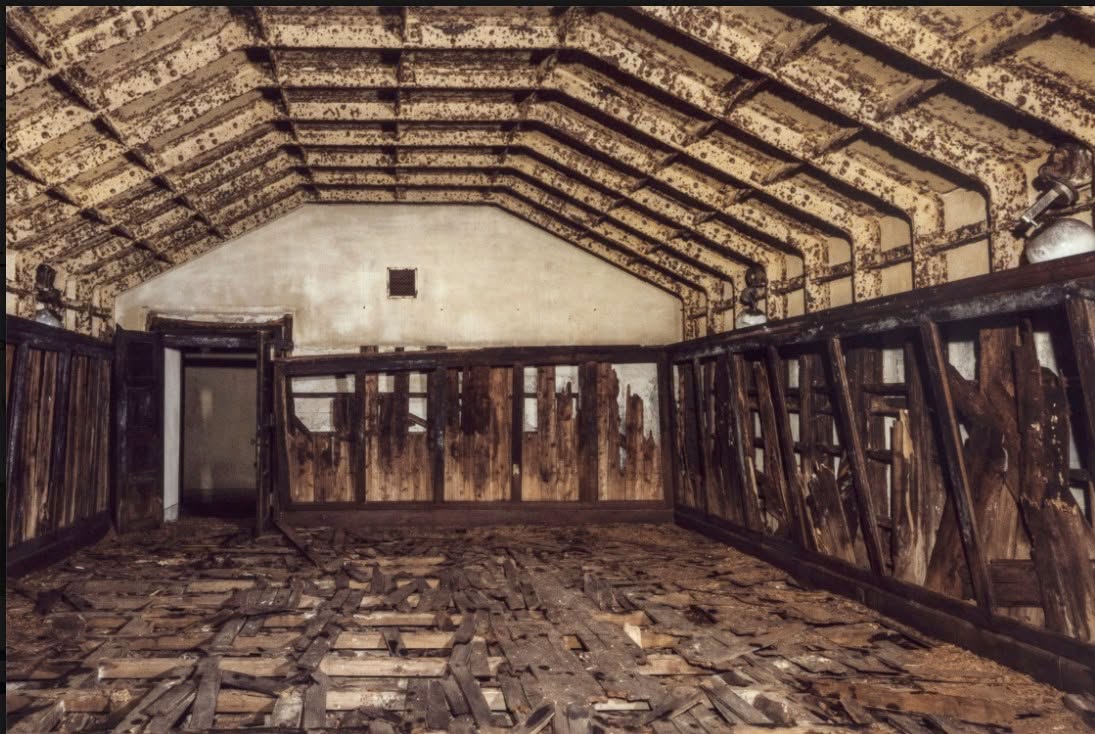
On August 9 the Council convened in their underground bunker at the Imperial Palace in Tokyo to continue their discussions. They learned that at midnight the Soviet Union had broken its neutrality, declared war on Japan, and invaded Manchuria. Any hope of using the Soviets to broker a peace deal was now lost, and Japan now faced the threat of being overrun and occupied by communists. That evening they received another blow—news that Nagasaki had been destroyed by another atomic bomb. But the Council remained at an impasse—the Peace Party advocated surrender with only one condition—that the emperor be left enthroned. The Party of War, led by Anami, insisted that in addition to that condition, any peace treaty must guarantee no trials for war crimes, no disarmament, and no occupation of Japan. If those terms were not accepted, they argued, then Japan should fight to the death.
At around 10:00 p.m. Prime Minister Admiral Kantaro Suzuki proposed convening an Imperial Conference. About two hours later, around midnight on August 10, 1945 (eighty one years ago today) Emperor Hirohito arrived and joined the meeting, taking his place on his elevated throne at the end of the room.
Both sides presented their arguments and made their cases. Eventually they fell silent and turned to the emperor. The decision was his and on it rode the lives of tens of millions of people.
Hirohito removed on his gloves, wiped his brow, and spoke in formal archaic Japanese: “I have given serious thought to the situation prevailing at home and abroad and have concluded that continuing the war can only mean destruction for the nation and prolongation of bloodshed and cruelty in the world. I cannot bear to see my innocent people suffer any longer… It goes without saying that it is unbearable for me to see the brave and loyal fighting men of Japan disarmed. It is equally unbearable that others who have rendered me devoted service should now be punished as instigators of the war. Nevertheless, the time has come to bear the unbearable…. I swallow my tears and give my sanction to the proposal to accept the Allied proclamation on the basis outlined by the Foreign Minister.”
It was what would later come to be called “the Sacred Decision,” and although Anami and the other War Party members deeply objected to it and resented it, disobedience to the emperor was treason. They had no choice but to obey. Later that morning, the Japanese Foreign Ministry sent a cable to the Swiss legation in Washington D.C., announcing that Japan accepted the terms of the Potsdam Declaration, provided those terms do not “prejudice the prerogatives of (the emperor) as sovereign ruler.” But it wasn’t over yet. The Allies responded that while pursuant to the terms of the Potsdam Declaration the ultimate form of government in Japan would be up to the freely expressed will of the Japanese people, in the meantime Japanese surrender must be unconditional. The Council’s consideration of the Allied response was as heated as their earlier debates. The Peace Party favored acceptance of the offer, trusting that the emperor would not be harmed and would be allowed to remain on the throne, even if under ultimate Allied control. For Anami and the War Party, however, the condition was offensive to the dignity of the emperor and blatantly unacceptable. The war should continue they argued, regardless of the cost.
Having heard nothing further from the Japanese for over three days, on August 14 President Truman authorized the largest and most sustained bombing mission of the war—sending over 700 B-29s to pound Japan. Meanwhile, he was proceeding with plans to use another atomic bomb, which was expected to be delivered by the end of the month.
On the night of August 14, Hirohito announced his final decision, overruling Anami and the War Party and announcing that Japan would accept the Allied proposal and surrender on their terms. He recorded an extraordinary message that was the next day broadcast to the Japanese people, who had never before heard his voice: “After pondering deeply the general trends of the world and the actual conditions obtaining in our empire today, we have decided to effect a settlement of the present situation by resorting to an extraordinary measure. We have ordered our government to communicate to the governments of the United States, Great Britain, China and the Soviet Union that our empire accepts the provisions of their Joint Declaration….”
A desperate coup attempt by pro-war hardliners aimed at preventing the emperor’s message from being played and at keeping the war going failed. When asked to join the rebels Anami replied: “I must obey my emperor.” Along with the rest of the Council he signed the surrender order. The next morning, he committed suicide. A few hours later, at noon, Japanese radio played the emperor’s recorded message.
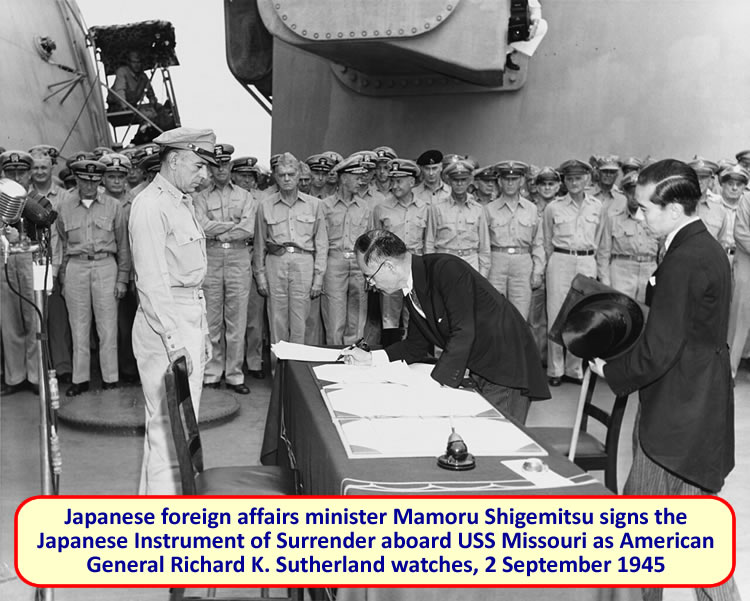
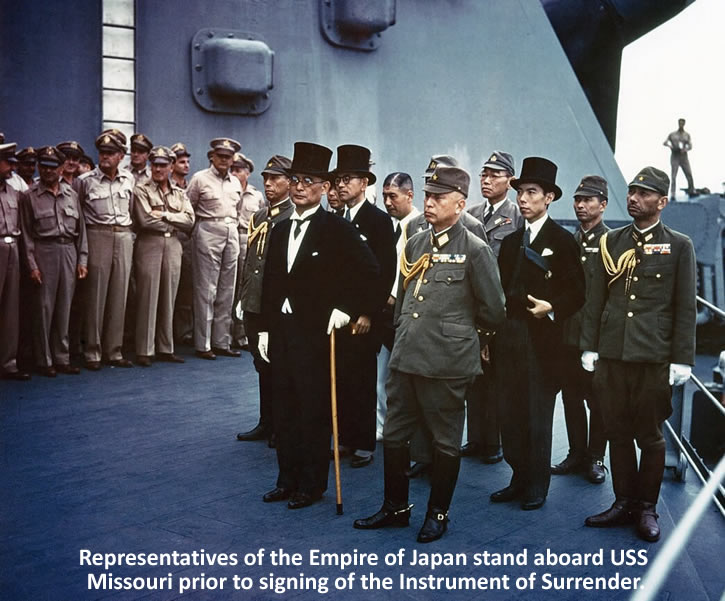
The formal surrender ceremony occurred in Tokyo Bay aboard the USS Missouri on September 2, 1945. World War II was finally over.
|