 |

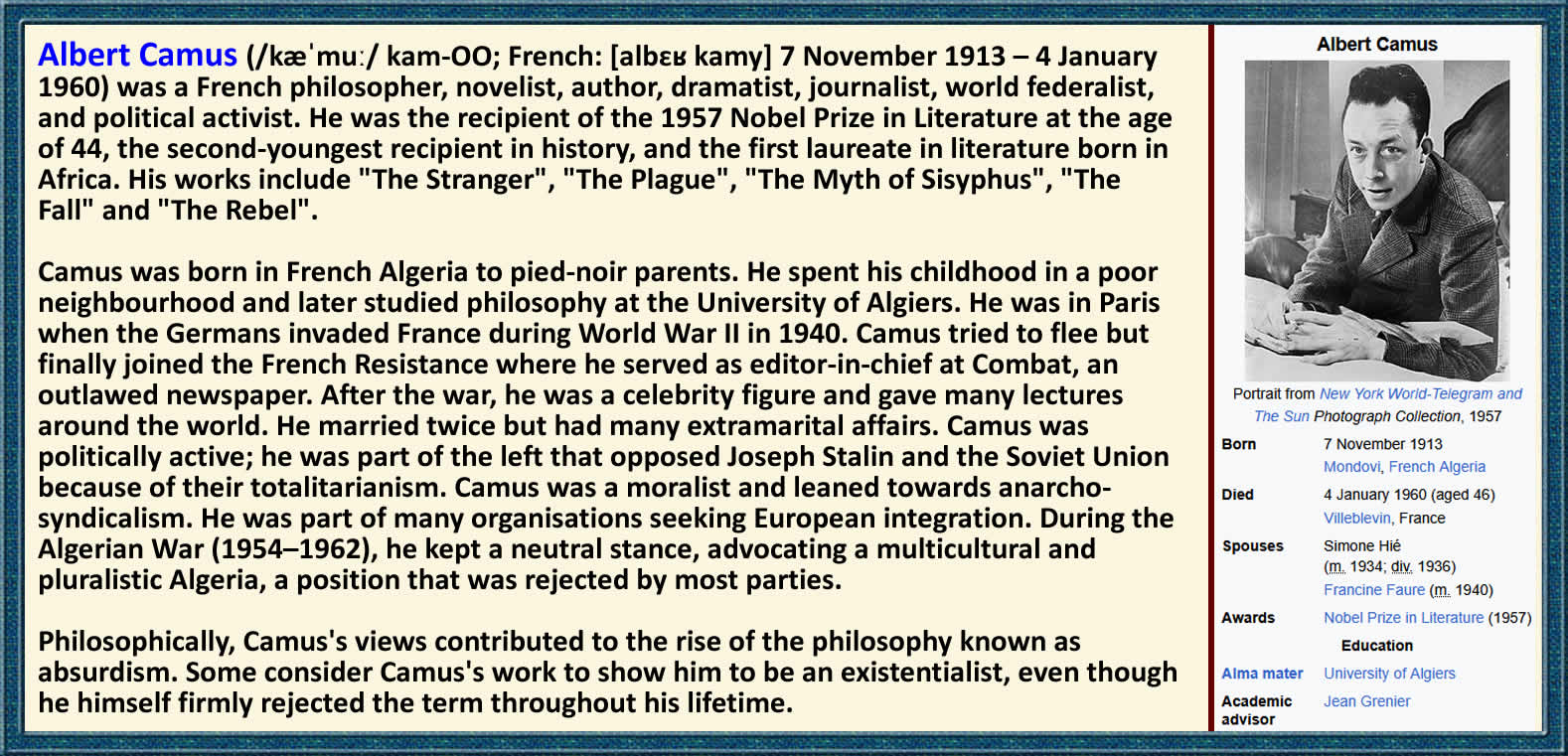
On December 10, 1957, Albert Camus stood before Swedish royalty accepting literature's highest honor. Nine days later, he wrote a letter that mattered more than the prize itself. "Dear Monsieur Germain," it began. "Without you, none of this would have happened." The story starts thirty-three years earlier, in a Algerian apartment so poor it had dirt floors. Albert Camus was born in 1913 into a kind of poverty that typically writes the ending before life begins. His father Lucien worked fields he'd never own, earning barely enough to feed his family. When World War I erupted, France conscripted Lucien and sent him to die at the Battle of the Marne. Albert was eleven months old. He never formed a single memory of his father's face. His mother Catherine was left with two sons, no education, partial deafness, and no ability to read or write. She scrubbed floors in wealthy colonists' homes while her mother - a harsh, domineering woman - ruled their cramped apartment with an iron fist. They lived in two rooms with a paralyzed uncle. There were no books. No conversations about ideas. No money for anything beyond survival. In 1920s Algeria, children like Albert had a predetermined path: school until fourteen, then straight to manual labor. Education was a luxury reserved for families with means. Poor boys became dock workers or farmhands. That was the natural order. Albert should have been invisible. But in 1924, a teacher named Louis Germain noticed something odd about the quiet, undernourished boy in his classroom. Albert barely spoke. He was small for his age. But when he wrote, sentences emerged with an unusual clarity - precise, honest, almost too sophisticated for a ten-year-old. The thoughts were mature. The observations were sharp. Something was there. Germain had taught hundreds of poor children who vanished into factories and fields right on schedule. He knew what the pattern looked like. He also knew when someone was about to break it. So Germain made a decision that required exactly zero institutional approval: he stayed after school every day and tutored Albert for free: not once a week, but every single day. He prepared Albert for the scholarship examination that would allow him to attend lycée - the secondary school that could change everything. Most teachers wouldn't bother. Why invest time in a boy whose grandmother would pull him out anyway to start earning money? But Germain went further. When Albert's grandmother declared he needed to quit school and contribute financially, Germain walked to their apartment himself and argued with her. He convinced her that this boy's mind was worth more than immediate wages. Albert won the scholarship. At eleven years old, he left the dirt-floor apartment and entered a world of books, philosophy, and ideas. He discovered he could use words to make sense of a universe that had killed his father and trapped his mother in silence. He started writing seriously. He started thinking about meaning and absurdity and human dignity. In 1942, while France suffered under Nazi occupation, Camus published "L'Étranger" ("The Stranger") - a novel about a man who commits murder and feels nothing, a meditation on meaninglessness that captured something essential about modern existence. It became one of the twentieth century's most influential books. He wrote "La Peste" ("The Plague") in 1947, an allegory about resistance and solidarity that sold millions. He joined the French Resistance during the war, editing an underground newspaper. He debated existentialism with Jean-Paul Sartre. He became one of the most important voices in postwar European thought. Then, in October 1957, the Swedish Academy announced he'd won the Nobel Prize in Literature for work that "illuminates the problems of the human conscience in our times." Camus was genuinely shocked. He thought André Malraux deserved it more. At forty-four, he became the second-youngest literature laureate in history. The ceremony on December 10 was everything you'd expect: formal dress, Swedish royalty, speeches in multiple languages, international press coverage. Camus gave a thoughtful address about the writer's responsibility to bear witness to suffering, to resist nihilism, to defend human dignity. It was a moment of absolute triumph: the orphaned son of an illiterate cleaning woman, standing at the pinnacle of literary achievement. But when the ceremony ended and Camus returned to his hotel, the first person he thought about wasn't a famous intellectual or political leader. It was the teacher who had stayed after school thirty-three years previously. On November 19, 1957, Camus wrote a letter. Like his novels, it was brief, precise, and devastatingly honest: "Dear Monsieur Germain, I let the commotion around me these days subside a bit before speaking to you from the bottom of my heart. I have just been given far too great an honor, one I neither sought nor solicited. But when I heard the news, my first thought, after my mother, was of you. Without you, without the affectionate hand you extended to the small poor child that I was, without your teaching and example, none of all this would have happened. I don't make too much of this sort of honor. But at least it gives me the opportunity to tell you what you have been and still are for me, and to assure you that your efforts, your work, and the generous heart you put into it still live in one of your little schoolboys who, despite the years, has never stopped being your grateful pupil. I embrace you with all my heart." Louis Germain wrote back immediately, deeply moved. He told Camus that despite international fame, he would always be "my little Camus." He said it brought him satisfaction to see that success hadn't corrupted the boy he remembered. The exchange reveals something crucial about how greatness actually works. We tell stories about individual genius as if brilliant people emerge fully formed from nowhere. We celebrate the Nobel Prize winner without acknowledging the invisible infrastructure that made the prize possible. But Albert Camus understood what most people forget: nobody succeeds alone. Every achievement has hidden hands behind it. Every "self-made" success is actually a collaboration between talent and someone who recognized it when nobody else did. Camus could have written that first letter to his publisher, celebrating commercial success. He could have written to Jean-Paul Sartre, acknowledging intellectual influence. He could have written to political leaders, building connections for future opportunities. Instead, he wrote to an elementary school teacher in Algeria - because Camus knew that Louis Germain's decision to stay after school mattered more than anything the Swedish Academy could bestow. The Nobel Prize recognized what Camus had written, but Germain had made it possible for him to write at all. Three years later, on January 4, 1960, Albert Camus died in a car crash on a rainy French road. He was forty-six. In his pocket was an unused train ticket - he'd planned to travel by train but accepted a friend's offer to drive at the last minute. The world lost one of its great moral voices. He left behind an unfinished autobiography about growing up in poverty, about his mother's silence, about teachers who saw potential in children everyone else ignored. The book was titled "The First Man". He was born on a dirt floor to a mother who couldn't read. A teacher tutored him for free because he saw something others missed. Thirty-three years later, he won the Nobel Prize. And he thanked the teacher first. That choice says everything about who Albert Camus actually was. The Swedish Academy honored his books. But Camus honored the person who made the books possible. Most Nobel winners thank institutions, patrons, fellow intellectuals - people who can advance their careers further. Camus thanked someone who had nothing left to give him except the knowledge that his effort had mattered. That's not gratitude as strategy. That's gratitude as integrity. We live in a world obsessed with individual achievement, where success is measured by how far you rise above your starting point. We celebrate people who "made it" and assume their talent alone explains their trajectory. But Albert Camus stood in Stockholm accepting humanity's highest literary honor and immediately thought about a teacher in Algeria who had stayed after school to help a poor kid with potential. He understood that the Nobel Prize wasn't his alone: it belonged to Louis Germain, too. Every teacher who has ever stayed late to help a struggling student, every mentor who has ever invested time in someone with nothing to offer in return, every person who has ever recognized potential that nobody else saw - they're all part of this story. Louis Germain gave free lessons to a boy who couldn't afford them. That boy gave the world "The Stranger", "The Plague", "The Myth of Sisyphus" - works that still illuminate what it means to be human in an absurd universe. And when the world honored him for it, he honored the teacher who had made it possible. That's the real story - not the genius who won the Nobel Prize, but the teacher who made sure genius didn't die on a dirt floor in Algeria. |