 |
 |
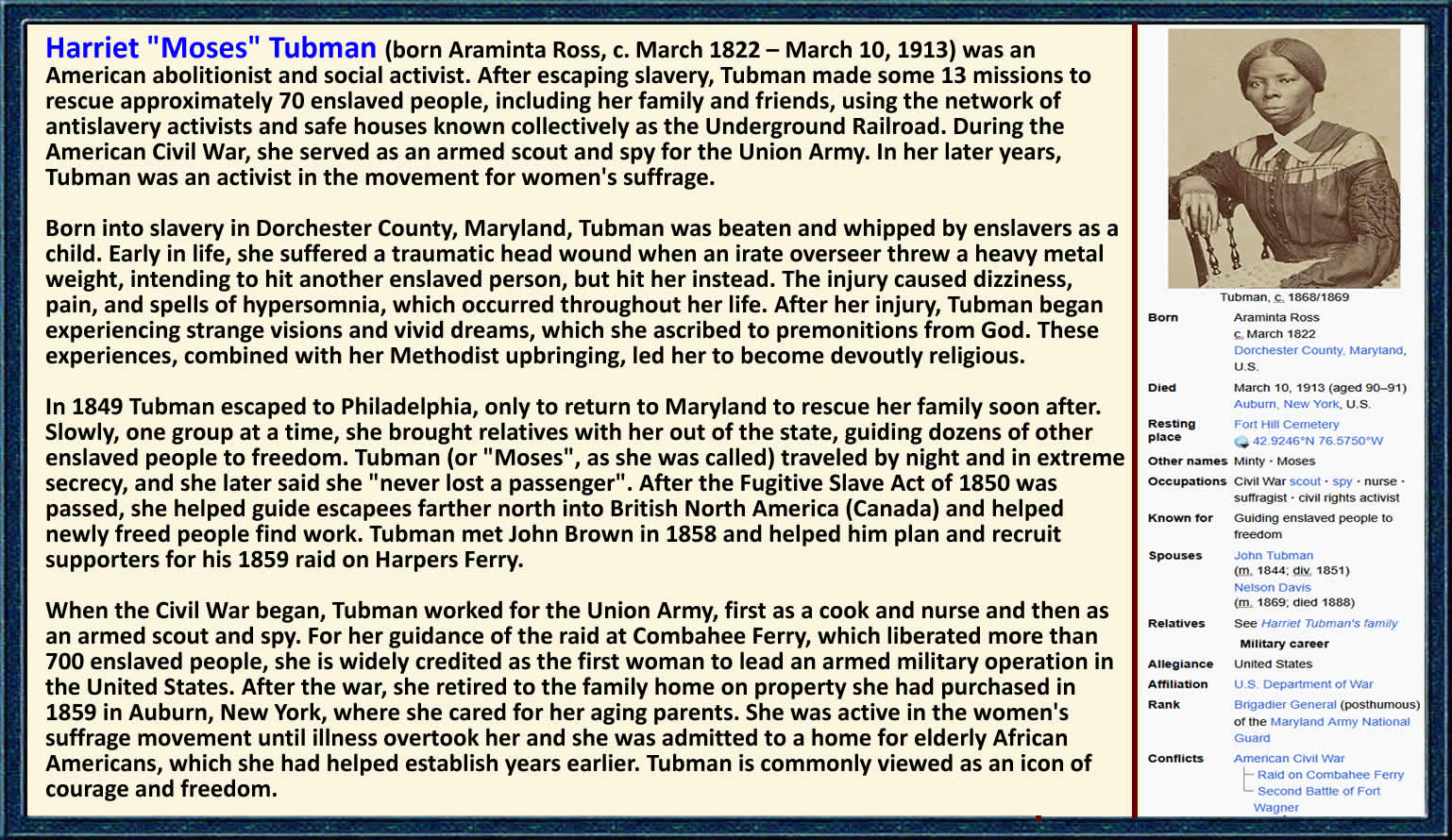
| On Veterans Day 2024, in a small park in Dorchester County, Maryland — just miles from the farm where she had been born into slavery — Harriet Tubman was finally commissioned as a Brigadier General of the United States military.
She had been dead for 111 years.
But some honors are worth waiting for. and some people are too large for history to ever truly bury. Most people know Harriet Tubman as a conductor of the Underground Railroad — the woman who made thirteen daring missions back into the South, guiding roughly 70 enslaved people to freedom through darkness, swamps, and the constant threat of death. A $40,000 bounty hung over her head. She was never caught. What fewer people know is what she did next. When the Civil War broke out, Tubman didn't retreat to safety. She volunteered for the Union Army, traveling to Port Royal, South Carolina — deep in Confederate territory — where she worked first as a nurse, then as something far more dangerous: a spy. She built a network of informants across the Lowcountry — people who moved invisibly through Confederate-held land, bringing back intelligence about troop positions, supply lines, and hidden locations. The same instincts that had carried dozens of people out of slavery now guided Union officers through enemy territory. Then, on the night of June 2, 1863, she did something no woman had ever done in the history of the United States: she led an armed military raid. Three Union gunboats moved silently up the Combahee River in darkness, navigating a route that Tubman had mapped — including the exact locations of Confederate torpedoes hidden underwater to sink enemy vessels. She had gotten that intelligence from her network. Without it, the boats would have been destroyed before reaching their targets. But they didn't. And at her signal, the steam whistles sounded. More than 750 enslaved men, women, and children came running from the plantations along the riverbank — having received word that liberation was coming. They poured onto the boats. Nine Confederate plantations were destroyed. Hundreds of thousands of dollars in Confederate supplies went up in flames. Harriet Tubman stood on those gunboats as the people she had freed wept and held their children and breathed free air for the first time in their lives. More than 100 of the men she freed that night joined the Union Army on the spot. Newspapers called her "the greatest heroine of the age." They praised her patriotism, her courage, her genius. A formerly enslaved woman had just outmaneuvered the Confederate military. But the U.S. government refused to pay her. For decades after the war, Tubman fought — legally, relentlessly — for a military pension. The country that she had risked her life to preserve told her, again and again, that her service didn't quite count. That the paperwork wasn't in order. That there wasn't a clear enough record. She finally received a small pension in 1899. Not for her own service — but as the widow of a veteran. She died in 1913, still unranked, still without the formal recognition her service demanded. And so last November, on Veterans Day, Maryland Governor Wes Moore stood in the county where she was born and corrected a century-old wrong. "Harriet Tubman lived the values I was taught when I served in the United States Army," he said. "Mission first. People always. Lead with honor, integrity, duty, and courage. Leave no one behind." Her great-great-great-grandniece, Tina Wyatt, accepted the commission on her behalf. She was visibly overcome. |
 |
 |
 |