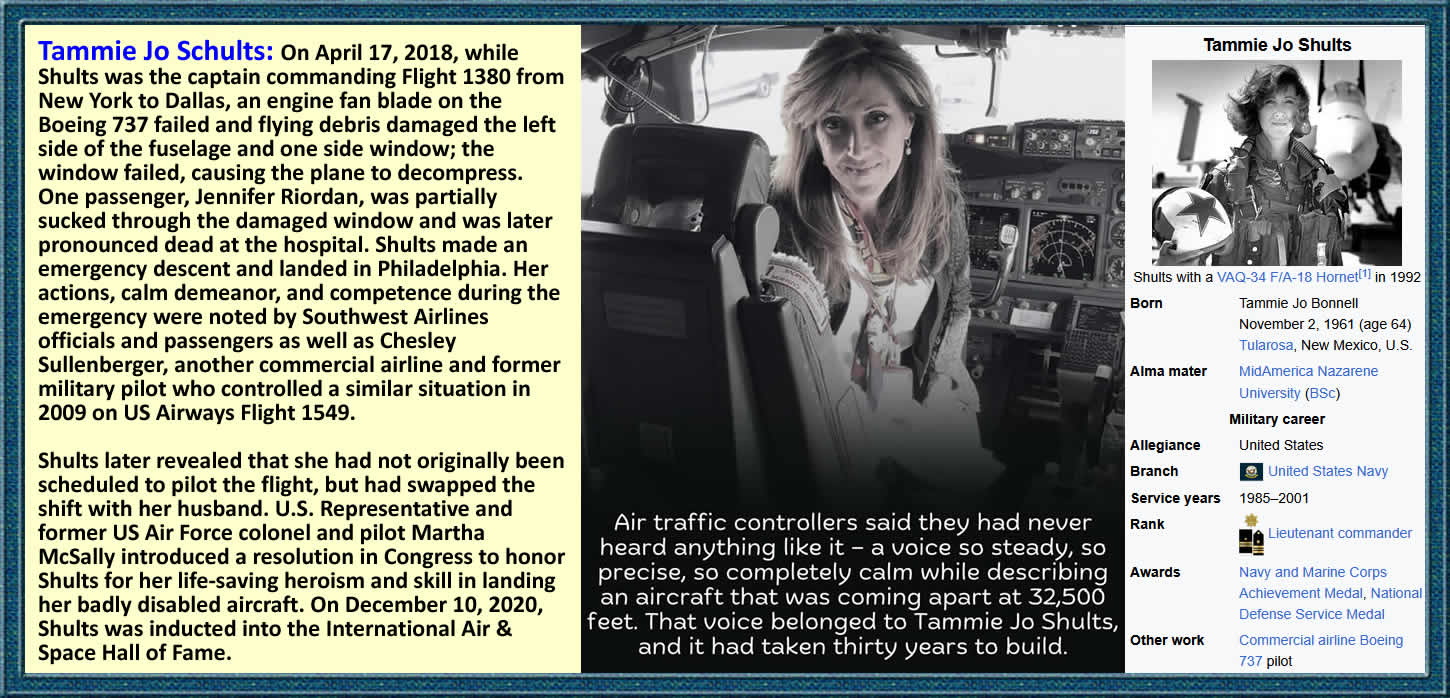
| The controllers in Philadelphia heard her voice before they fully understood what she was describing.
It was steady, measured, precise. She used clean aviation language to lay out a situation that would have broken the composure of almost any human being — one engine operating, a section of the aircraft missing, a cabin in crisis at 32,500 feet. The controllers worked emergencies regularly. They had heard pilots under pressure hundreds of times.
They would later say they had never heard anything quite like this.
What they were hearing was Tammie Jo Shults.
What they were hearing was thirty years of preparation arriving at the moment it was built for.
She had grown up in New Mexico with a dream of flight and a system that had decided, with the full confidence of official policy, that women were not part of that future. When she approached the Navy about becoming a pilot, the answer was institutional and absolute. Women could not fly combat aircraft. The door wasn't partially open. It had been closed for the entire history of American military aviation. When the combat exclusion policy was lifted in the early 1990s, she was ready. She became one of the first women to fly the F/A-18 Hornet — a high-performance fighter that demands physical and technical mastery at the highest level the discipline produces. The Navy then put her in charge of teaching other pilots how to survive when everything went wrong at once; how to hold control when an aircraft entered a spin; how to think with clarity when the instruments were lying and the aircraft was actively working against you. She took pilots the rest of the world already called elite and made them sharper. On April 17, 2018, Southwest Airlines Flight 1380 left LaGuardia Airport in New York with 149 people aboard, headed to Dallas. Forty minutes into the flight, the left engine exploded. A fan blade had fractured and torn free, sending shrapnel through the engine housing and into the fuselage. A window shattered. The cabin depressurized in an instant. A passenger named Jennifer Riordan, a bank executive and mother of two from Albuquerque, was partially pulled toward the broken window before the people beside her grabbed her and pulled her back. The aircraft shook with a violence survivors described as unlike anything they had ever experienced. The noise was something they would not find words for later. Passengers reached for their phones and began texting the people they loved. In the cockpit, Tammie Jo Shults reached for the controls. She keyed the radio and spoke to Philadelphia approach control in the same tone a pilot uses to request a routine taxi clearance. She told them she had a single engine. She told them part of the aircraft was missing. She told them she needed medical personnel on the runway when she arrived. The controllers responded to what she was saying. She responded to what the aircraft needed. The engine was gone. Asymmetric thrust was pulling the plane toward the dead side. The fuselage had taken shrapnel damage. The cabin was in full emergency. She flew by feel, drawing on the emergency expertise she had spent a career developing and then teaching to others. She held the aircraft stable. She located Philadelphia. She built the approach. Twenty minutes after the engine exploded, she put the plane down on Runway 27L. She landed it so cleanly that passengers who had spent twenty minutes certain they were about to die needed a moment to understand it was actually over. Then she did something that revealed everything about who she was when the emergency ended. She walked the aisle. While emergency personnel worked and the aircraft was still being secured, Shults moved through the cabin and checked on every single passenger personally. She introduced herself. She asked how they were doing. She looked each person in the eye — the people whose lives had just been in her hands — and made sure, face to face, that they were going to be alright. Jennifer Riordan did not survive. Her death, the only fatality, has stayed with Shults. She has spoken about it with quiet grief in the years since. One hundred and forty-eight people walked off that aircraft because of what happened inside the cockpit during those twenty minutes. She told the full story — the Navy years, the closed doors, the flight, the walk through the cabin — in her 2019 memoir "Nerves of Steel". She wrote about faith and family and the specific quality of calm that doesn't come from the absence of fear. It comes from preparation so thorough that fear has less room to take hold. The world had once told her the cockpit wasn't hers. On April 17, 2018, with one engine gone and 148 lives suspended in the balance, the sky rendered its own verdict on that claim. Her voice never wavered. Her hands never faltered. She brought them home. |
|