 |
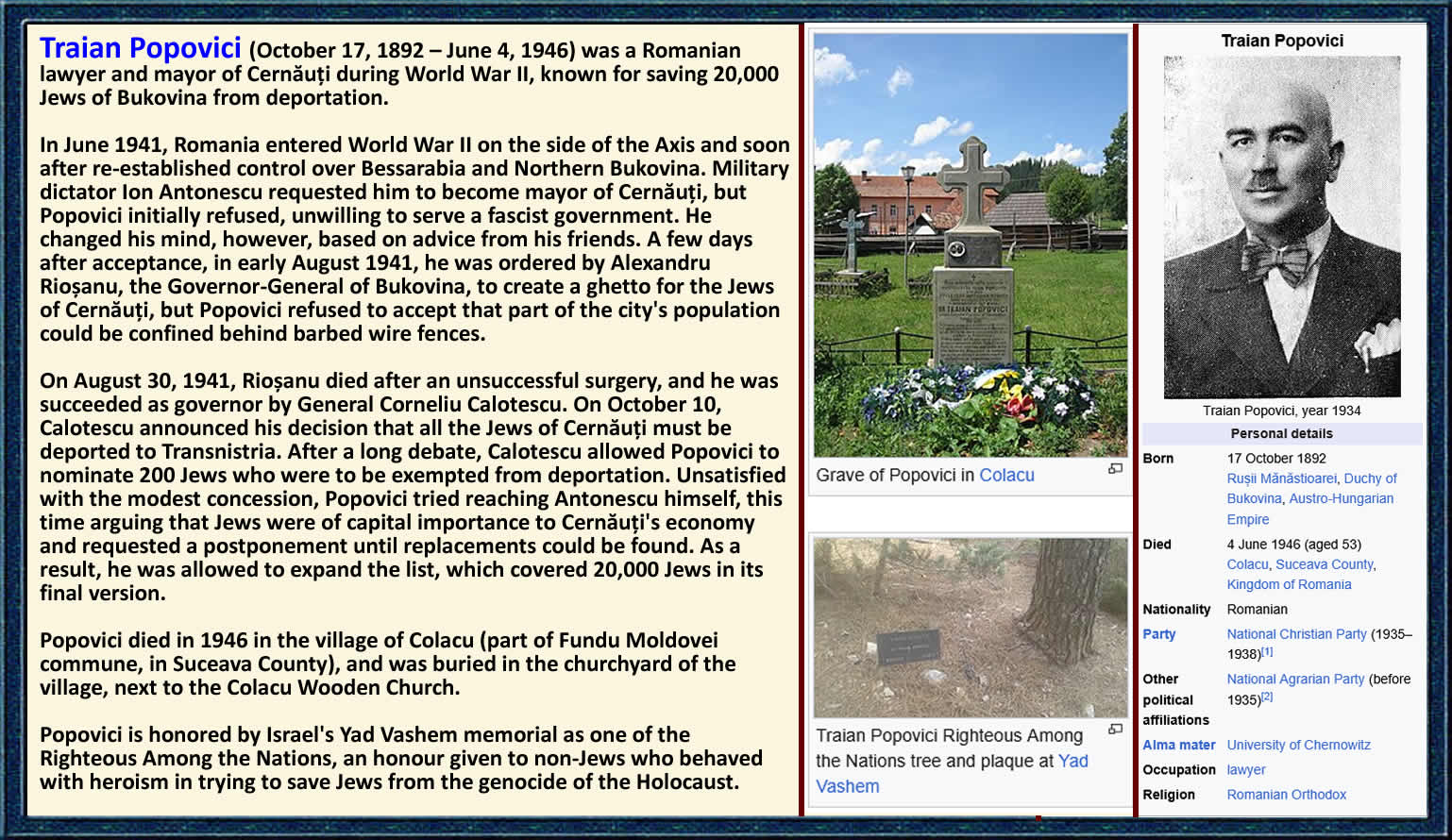
| Traian Popovici was born on October 17, 1892, in Ru?ii Manastioara, Romania. He became a lawyer and entered public service, eventually becoming mayor of Cernau?i (Czernowitz, now Chernivtsi in Ukraine) in October 1941. Cernau?i was a major city in Romanian Bukovina with a large, prosperous Jewish community of approximately 50,000 people before the war - about half the city's population.
In June 1941, Romania allied with Nazi Germany and invaded the Soviet Union. Romania occupied Soviet territories including Transnistria, establishing a brutal occupation regime. Romanian dictator Ion Antonescu implemented policies of Jewish persecution comparable to Nazi policies - deportation, ghettoization, mass murder.
In October 1941, Romanian authorities ordered the deportation of Jews from Romanian-controlled territories to Transnistria - a region between the Dniester and Bug rivers that Romania controlled. Transnistria wasn't technically part of Romania but was under Romanian administration. The regime established concentration camps and ghettos there where conditions were horrific - starvation, disease, exposure, mass shootings. Approximately 150,000-200,000 Jews died in Transnistria.
When deportation orders came for Cernau?i in October 1941, Traian Popovici had just become mayor. He was forty-nine years old, a respected lawyer and administrator. The orders were clear: deport the city's Jews to Transnistria. Romanian authorities authorized Popovici to issue only 200 work permits - exemptions for Jews whose labor was essential to city functioning. Popovici faced an impossible choice: enforce the deportation orders and watch 50,000 people - half his city's population - be deported to death camps or defy orders and face dismissal, arrest, possibly execution. Popovici chose defiance. He issued not 200 work permits but approximately 20,000. He massively exceeded his authorized quota, providing work permits to entire families, claiming that thousands of Jews were essential workers whose deportation would cripple the city's economy and infrastructure. This was systematic, deliberate violation of Romanian government orders. Popovici knew exactly what he was doing - protecting 20,000 Jews from deportation by claiming they were all essential workers when most weren't. He coordinated with Jewish community leaders including Chief Rabbi Dr. Mark to identify families needing protection and distribute permits. The 20,000 Jews with Popovici's permits remained in Cernaui while approximately 28,000-30,000 Jews from the city and surrounding areas were deported to Transnistria in late 1941. Those deported faced horrific conditions - most died from starvation, disease, exposure, or were murdered, but the 20,000 with Popovici's permits survived in Cernaui. They weren't deported. They remained in their homes, continued working, stayed with their families. Popovici had saved them by issuing 19,800 more permits than authorized. Romanian authorities were furious. Popovici had flagrantly disobeyed deportation orders. He'd undermined government policy by claiming 20,000 Jews were essential workers when clearly most weren't. In March 1942 - just five months after becoming mayor - Popovici was dismissed from his position for insubordination and unauthorized protection of Jews. Popovici returned to private law practice. He'd lost his political career but saved 20,000 lives through five months of defiance. The war continued. The 20,000 Jews Popovici protected remained in Cernaui, surviving while Jews in Transnistria died by the tens of thousands. When Soviet forces liberated the area in 1944, Cernaui's Jewish community had survived largely intact - one of the few Romanian Jewish communities where substantial numbers lived through the war. But Popovici faced new persecution. When Soviets occupied the region, they arrested Popovici multiple times, viewing him as a former Romanian official who'd served under Antonescu's fascist regime. The Soviets didn't care that Popovici had saved 20,000 Jews - they saw him as a fascist collaborator. After the war, Romania came under communist control. The new communist government also persecuted Popovici. He was arrested and interrogated. His wartime role as mayor under Antonescu's regime made him suspect despite his rescue work. The stress, persecution, and arrests destroyed Popovici's health. On December 4, 1946, at age fifty-four, Traian Popovici died of a heart attack in Bucharest. He'd lived only two years after the war, spending those years facing arrest and persecution rather than recognition for saving 20,000 lives. For decades, Popovici remained largely unknown. Communist Romania didn't celebrate him - acknowledging his heroism meant admitting a Romanian official had defied Antonescu's deportation orders, complicating the regime's narrative. The Jewish survivors he'd saved knew what he'd done, but his story wasn't widely told. In 1969 - twenty-three years after his death - Yad Vashem recognized Traian Popovici as Righteous Among the Nations for saving approximately 20,000 Jews by issuing unauthorized work permits. The recognition came posthumously, decades after Popovici had died from stress-induced heart attack following persecution by Soviets and communists. From Romanian lawyer to mayor of Cernaui. From October 1941 deportation orders to issuing 20,000 unauthorized permits. From five months of defiance to dismissal in March 1942. From surviving the war to Soviet and communist arrests. From death at age fifty-four in 1946 to recognition twenty-three years later. Traian Popovici proved that municipal officials could defy national deportation policies when they decided protecting citizens mattered more than obeying orders. That issuing 20,000 work permits when authorized for 200 was possible when a mayor decided the city's Jews deserved protection regardless of government policy. He proved that the cost of defiance was losing your position - dismissed after five months for insubordination. That surviving the war didn't mean peace - Soviets and communists arrested and persecuted him for being Romanian official under Antonescu despite saving 20,000 Jews. That persecution and stress killed him at fifty-four, just two years after liberation. The 20,000 Jews Popovici protected survived because a Romanian mayor issued work permits far exceeding his quota. They remained in Cernau?i while 28,000-30,000 others were deported to Transnistria and died. They lived, had families, built futures. Researchers estimate tens of thousands of descendants from the Jews Popovici saved. But Popovici died at fifty-four from heart attack caused by years of persecution. He was arrested by Soviets who didn't care he'd saved Jews. He was arrested by communists who saw him as fascist collaborator. He spent his final two years facing interrogation and persecution rather than receiving recognition. And he died twenty-three years before Yad Vashem recognized him. He never knew the world would eventually acknowledge that issuing 20,000 unauthorized work permits had been heroic defiance rather than insubordination worthy of dismissal. That's the cost Popovici paid - five months as mayor, dismissal for saving Jews, two years of postwar persecution, death at fifty-four from stress-induced heart attack, and twenty-three years of being forgotten before posthumous recognition came. The 20,000 Jews survived. Popovici died young, persecuted and unrecognized. Those are the brutal facts - heroism that saved 20,000 lives but cost the hero everything including his life at fifty-four and decades of obscurity before the world admitted he'd been right to defy deportation orders. |